Monday, 28 March 2011

Love Me- Zed Nelson, natalie kirk (books/web)


Love Me- Zed Nelson
Over a period of five years, travelling to seventeen countries, across five continents, photographer Zed Nelson has produced his latest work entitled LOve Me.

In the series Nelson explores the world we have created in which the way you look can have enormous social and psychological rewards and downfalls. A world in which our constant strive for perfection is so great that plastic surgery and the odd 'nip and tuck' is fast becoming the norm.

The series presents images of Beauty Queens to Business Men, Hou
se Wifes to Plastic Surgeons, all sharing one common beli
ef that in changing your appearance on the outside others around you will accept and admire you as 'beautiful'.


One image that stood out for me was that of Anthony Mascola, age 46. Nelson shot him as he was just hours away from undergoing liposuction surgery to his abdomen and chin. The image is accompanied by a quote which reads:

"I'm competing with me 20 years younger than me"
What is it that makes this man feel inadequate to those younger than he? Is it a natural part of growing old to feel as if you want to turn the clock back? Is it just that now you can. Perhaps the fact that cosmetic surgery has become so accepted is part of it's attraction, it's almost seen as a quick fix, a way of solving all your problems, a way of gaining that confidence you so desire.

Another quote with the work is that of philosopher Alain de Botton:

Every society has notions of what one should believe and how one should behave in order to avoid suspicion and unpopularity. Some of theses societal conventions are given explicit formulation an a legal code, others are more intuitively held in a vast body of ethical and practical judgements described as 'common sense' which dictates what we should wear, which financial values we should adopt, whom we should esteem, which etiquette we should follow and what domestic life we should lead.
We refrain from questioning the status quo because we associate what is popular with what is right.

To me Nelsons work is hugely important, it brings our attention to the lengths in which people will go to to achieve their notion of what is right and what is beautiful.
It also makes us consider our own insecurities and vanity. Where has this strive for perfection and acceptance come from?What is it that we're aspiring to? What is beauty?


Carmen and Alec Soth: Brighton Picture Hunt: Periodicals

What do you do if you've been commissioned to produce work for Brighton photo biennial, only to find that on arrival to the uk, you do not have the correct papers to work?  Marketing is in swing; Martin Parr is already taking about you to the press. Bit of a problem it may seem. But If you're Alec Soth, how about collaborating with your seven year old daughter?


Although this collaboration with Soth's seven year old daughter should be seen as a light hearted, creative and humorous solution to a tricky situation, there's also some deeper questions raised; should the validity of these images be questioned? Although Soth did all of the editing and this does bring to light that the vernacular can be amazing. the cynical question that springs to mind is; has Soths reputation got something to do with it? It seems to be a bit like the emperors new clothes. Carmen sees the world as it is; without all the hang ups of a photographer. Carmen sees things from her perspective. This is a refreshing thing. Soth showed some students these images and they all agreed they were fantastic; One noticed that they were all shot from a very low angle yet no one questioned Soth's authorship. This to me is so interesting, It is Alec Soth after all. What actually makes a photographer? Carmen had been fully involved in the project. Although editing was all down to her father, It may have been a solution to a problem, but I think it has ended up highlighting something very interesting.


This sort of naive perspective, either intentional or otherwise, is becoming increasingly prevalent in photography, says Soth. "We're highly visually literate right now, so I think people are responding to things that feel real and uncrafted. Take Wolfgang Tillmans – he obviously knows everything there is to know about photography, but he manages to look like he's not trying.

The thing that stays with me regarding these pictures is the freedom a seven year old with a camera has; Carmen is not intimidating, nor intrusive. the images relay this. How refreshing! there is something so honest from this perspective. The future interview with Carmen in Photoworks seemed contrived; for me the whole point is about a child's perspective - otherwise, it could just be looked at as an exploitative exercise. I do however see this as a great thing for young people to see their peers in galleries and this is a good point. 

“My head is filled with nuanced cliches – I might subconsciously be influenced by William Egglestone – but she doesn't have that framework. Of course, as a professional, you can't go back to a time when you had none, but you can try. Myself, I long for that quality again." Alec Soth

Future interview with Carmen Soth Photoworks 2011


Photography After Photography: Books

Pedro Meyer:Pedro Meyer describes this image as being 'truthful to New York', but I can not see sense in his reasons as this is a digital composite and is far from the truth. In his book 'Truth & Fictions: a journey from documentary to digital photography' he describes his thoughts on a few of this composites he has produced over the years. He talks about his work being truthful to the subject of his composites. However, Meyer's earlier work was more 'credible' as the documentary works saw him not doing theses drastic changes that he does to his later work. Some of this images are creatively done; some you can't even notice the changes because of his good use of post-production software, one of these being Biblical Times, New York, 1987/93. However, some of his images have ridiculous concepts and the composites he chooses just do not work, like the Temptation of the Angel, 1991/91.

There is a lot of digital composites in use within the News and other media formats. These are used to bring across stronger messages and to shock the public more then the original image could ever do. A lot of composites used in the News are used to grab the attention of the audience and this can put across the wrong message and lead to the wrong impression, like the image someone had done just after the 9/11 incident which caused an up roar especially with in families and friends of people who died. This is one was a digital composite could be used in the wrong way.

Meyer,P (1995) Truth & Fiction: a journey from documentary to digital photography, Aperture Foundation, New York.

Lisa Oppenheim (Source-Athens)


I've always been a fan of using classic medias such as film and polaroid when it comes to photography as they seem to carry sentimental value and personal character. In 2007 instant cameras were no longer being made and in February 2008 the company Polaroid decided to cease all production of their instant films in favor of the new digital age. Polaroid isn’t the only media that has been fazed out by new and up to date techniques. Koadakrome (colour reversal film) was also let go in 2009 due newer competing colour films that were easier and cheaper to process. It can still be found in the hands of professionals or archives because of its long term stability but has definitely been taken out of the commercial eye.

Art Review in London had noticed this change in the photography scene and drew attention to the work by photographer Lisa Oppenheim. In the 2008 article they discuss the project
'Invention without a future' where Lisa quoted 'Legions of craftspeople, such as negative cutters, printers and lab technicians, have found themselves in a world where their enormous and specialized skills have been rendered obsolete. Their knowledge is not being passed on to another generation as it was passed to them'. I like the idea behind the project and exhibited work as the photographer is trying to record the media before it becomes obsolete. Looking through her work there are images produced with not just polaroid’s but Cibachrome photograms and Lunagrams.

http://www.harrislieberman.com/lisa_oppenheim/lisa_oppenheim-2009-12.html

I think photography and
installation work like Lisa Oppenheims is important to remind us of the life cycle of photography, its process of aging and where it came from. It has definitely evolved over hundreds of years and provided more reliable and newer techniques. This project and work allows us to see the modern view of out grown medias that have reached their end. They seem to have a beautiful elegance to them and represent the skills that should be remembered by every generation.

Thomas Ruff- Book Stock


Thomas Ruff

'Portraits'

From 1981-1985 Ruff produced the project ‘Portraits’. He used 100 people that he knew (friends, family and people from the academy he worked at) and took pictures of them. Each image was of th
e same size and composite. He based the framing upon Bust Portraiture (This is from just below the shoulder; the bust, and includes up to the head). He states in his book, that he wanted them to be shot this way as he believes that “Photography only ever shows the surface of something anyway”. Every person that was used sat on the same stool, therefore, at the same height for each image. He also stated before they had their picture taken, that he wanted them to have a serious yet calm expression. This was to show no feeling like smiling or ‘flirting’ with the camera. This was to stop any emotion in the images at all. Models wore their own clothes that they felt comfortable which i suppose gave them their identity as everything else in the image seems to be recorded and pictured in a clinical and structured way. For the background he chose different coloured cards so that the images didn’t look too flat. He asked each person to choose the colour they wanted to use. He got this idea from a TV magazine in which a celebrity would be featured on a full p
age spread with a different background each week.

Throughout the whole project, there are two images of twins. Why has he shot these two people together? I understand that they look exactly the same, and maybe the images would also look the same, but surely this gives two people one identity? Are these two people only seen as one or do they have their own personalities?

Ruff finalists some of this images by putting them in a set of 4. This way, the viewer can see each person as individuals, but also see similarities between two people. This can depend on the clothing they chose to wear, how they did their hair and also the background colour they chose.

Looking at the images below, he has clearly chosen 4 people that i as
sume are quite different. The gentleman on the bottom right seems quite laid back and young. However, the woman next to him looks rather career driven and well presented.

This is just my opinion, other people would probably think something different? But what i like about this project is that the viewer is left to make their mind up about what job they have, where they
are from, the class status, are they a criminal, etc.


Book from Stockport College library.
'Thomas Ruff. 1979 to the Present'

Loretta Lux - athens

Loretta Lux is a painter and her training in this medium has enabled her to construct photographs using her painting techniques. "I still think as a paitner, especially in terms of strcuturing a picture... I carefully choose the models, costumes, requisites, and backdrops of my photographs." As photography is growing and new technology had developed, this gives rise to many new elements and uses, combining art and media. "Usually i work with a digital camera and compose my works digitally or give them a finish on the computer, in order to make them meet my ideas perfectly." Her images of changelings are described as beautiful, extremely formal and chilling. The children in her images usually pose alone in either bleak landscapes or bare interiors, unsmiling with wide empty eyes. Lux expressed that her images portray a "forlorness as a basic experience of human existence." More noticeable, though, is the photographic context of childhood itself.
Lux's native Germany is the land of Heinrich Hoffmann's Struwelpeter. Also the child-snatching Erlkoenig and the tales of the Brothers Grimm. Germany is not the only country that has produced this creepy netherworld for children thoughout the years. Young children around the world sit staring wide-eyed through the dark violence of movies such as Spider-man or Batman and revel in the story of Lemony Snicket's 'Series of Unfortunate Events' Bruno Bettelheim reminds us in the Uses of Enchantment: children love entertainment and fantasy, and for good reason. In the simplicity of the good and evil characters "the child gets ideas about how he may create order out of the chaos which is his inner life." Lux's focus on forlornness within her images could relate to the inappropriate way in which individuals, in retro-blindness, envision childhood. Of course, as simple as she indicates; childhood is as chaotic and varied as any other part of life.
"I don't have a motherly eye. I enjoy working with children because they are genuine; they don't wear masks." Lux descibes her images of children as 'imaginiary portraits', and this may lead us to conclude that they are not real, that they are surreal. In her words "the creative will to making a reality that differs from what I find in memory and imagination." These children are, in fact, a creation of Lux's imagination; as fictional as the work of the grand masters that she so admired, but also non-fictional and completely unique.

Book Resource - "Twilight" by Gregory Crewdson

"Twilight"

Photographs by Gregory Crewdson


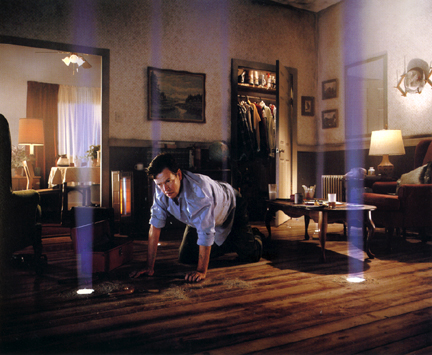
Upon first discovering Crewdsons work, I was particularly interested in the techniques used to construct his images. This is especially true in his collection of photographs in the "twilight" series. Crewdsons method is to build fabricated set-ups in constructed environments, often using lighting associated with the film industry. This gives his images an incredible sense of drama and an intriguing narrative emerges from his work.


The Twilight series addresses a number of issues often seen in Crewdsons work. Aside from his usual themes, Twilight also creates some interesting questions relating to suburbia and the "normality" we often associate with the domestic environment. His images are often shot indoors, however a strong sense of an almost artificial natural world emerges - Over saturated, bold greenery is placed inside the domestic living room, for example. We know this is out of place and doesn't fit however Crewdsons "characters" interact with the natural elements in a very familiar way.


This unnatural vs natural is an incredibly strong theme in the Twilight series. His images combine many opposites to question the reality of the shot - beauty vs horror, real vs surreal and familiar vs unknown. Even the familiar domestic landscape is challenged by the viewer seeing under the floorboards and into the unknown. The thing I truly love about Crewdsons images in the Twilight series are the questions they raise. I have an almost insatiable desire to know what is the story behind the shot. Why does the young girl look longingly into the school bus to the waving gentleman? Who is the woman in the flooded house and what has happened to her? The highly theatrical nature of the constructed film-set style environments would be engaging in most images, however Crewdson uses light in a such a sensitive way that only intensifies the drama within the frame. His work continues to be a great inspiration to me and is perfectly subtle look into surrealism and our desire to question our reality.


Periodicals 'God is in the Details'

Article about photographer michael Thompson, he does lots of work for beauty and fashion magazines. Thompson photographs celebrities such as model, Heidi Klum and actresses Gwyneth Paltrow, Milla Jovovich, Kate Hudson, Selma Blair and Julianne Moore. Quote from Thompson on his work... "There's nothing wrong with an out-of-focus, grainy picture, so many amazing images are like that..." "... you can have a beautifully lit, beautifullt techinical photo but if it doesn't have that feeling behind it, then its really nothing". Thompson has made images for beauty and fashion magazines and its a world where everything has to be perfect. From reading the article it becomes very clear that the more you search for perfection, you start to see the beauty in imperfections. Having celebrity status puts pressure on the person to be 'perfect' bu there is only so much they can do, where as a photographer, with the help of post production work can achieve the perfect image that the magazines want to promote. Professional Photographer, April 2011. 'God is in the Detail' by Joss Stone.
Social Networking - Books/own opinion I had some trouble finding information about social networks in the library, so i decided to give my own opinion about them. The top 3 most used social networking sites on the internet are Myspace, Twitter and the most popular of them all is Facebook. There are more than 500 millions users signed up to Facebook, 50% of them log on at any given day, the average user has over 130 friends and people spend over 700 billion mintues on facebook a month. More than 30 billion pieces of content shared each month. One of them is photographic images. One of the main features for Social Networks is Photo sharing, over 60 million photos are added each week, this makes photography one of the most important parts of creating a social networking profile. Using a social network not only lets you communicate with friends and family, but it is also used as an electronic photo album, it lets you upload almost any and every photograph you take with a camera. Now as the popularity of using social networking grows, the demand to upload more and more images grows also, now it seems that people have to upload images of anything an everything, such as holidays, weddings, birthdays, days out and just day to day life. From coming from an age of people sticking family photographs into albums, to entering a new age of uploading many images at a time and not worrying if the will be worn out with time. I have come to think of what the future holds for photograph albums in social networking sites and what new ways to store and view photographs will come in the future.

Sebastiano Salgado "Workers: an archaeology of the industrial age". (books)

Sebastiano Salgado was born in Brazil in 1944. After a short career as an economist in age of 29 he started working as a photojournalist and few years later moved to documentary photography. Salgado’s book was published in 1993 and presents final effect of seven years of traveling around the planet mainly to the “forgotten” places where world’s poorest fight for their existence. Our look is attracted by beauty and honesty of these photographs. They take us on a fascinating and true journey through perseverance, grace, dignity, devotion and endurance of working people. There is noticeable line dividing his work from typical photojournalism practice which main aim is to inform. We can see here Salgado’s sensibility and ability to identify himself with characters in photographs. Many times, during his travels, he “shared a bed” with them. Salgado clearly indicate one of the most important problems of first world civilization – its ignorance and brutality in striving to achieve its own goals; and building future on fundaments of poverty of third world. Although it is difficult not polemicize with Salgado. In dedication author says: “This book is an homage to workers, a farewell to a world of manual labour that is slowly disappearing and a tribute to those men and women who still work as they have for centuries”. He wrote these words just after second world fell into ruins. From perspective of nearly twenty years we can see that new millennium didn’t bring a change and poverty and manual labour spread even more widely across the world. Are we witnessing the situation where Fritz’s Lang vision became a true? Salgado also says: “The destiny of man and women is to create a new world, to reveal a new life, to remember that there exists a frontier for everything except dreams”. I think that in our world as it is in the eternal course of nature not all dreams and voices will be audible in creating a new future. Documentary film about Salgado (part one): http://www.youtube.com/watch?v=5X76jieUgTQ&feature=related