Sunday, 1 January 2012

The body as an aesthetic object

articles via the web

The body is viewed in many different notions. One body can be seen in many different ways when viewed by a number of people (aesthetically pleasing or not) but whether a body is seen in a good light or not, there is a sense of natural and aesthetic beauty that surrounds the subject- this concept has been used and manipulated time and time again by photographers, artists, writers, sculptors and many more variations…

However the work of artist Spencer Tunick, documenting the live nude figure in vast public installations using a mass culmination of bodies, grouping them together to metamorphosis into a new shape. Using the body as the natural aesthetic beauty it is, but more than that, using it grouped together to create a whole new aesthetic object itself…


His work consists on the availability of volunteers who are not afraid to show off their body, to be used in this aesthetic installing way, completely changing a man made area as such just by the use of their bodies...

 'the bodies extend into and upon the landscape like a substance.' - spencer tunick bio- www.spencertunick.com/bio

Using peoples bodies in this way, underlines the powers of the human body to completely encompass an environment, and create a new aesthetic feel over the man made (sometimes cold) structures, a feel of liberation from hiding your body away to flaunting and embracing the aesthetic plus sides and down sides of your body. In this sometimes complex issue of presenting art in this way in a public space. 


'These grouped masses that do not underscore sexuality become abstractions that challenge or reconfigure one's views of nudity and privacy'  - spencer tunick bio- www.spencertunick.com/bio

The notion of the naked body on mass used in a more aesthetic and artistic way can be hard to take in as it has the unusual feel around it, but on viewing, contrasts and similarities appear the body can mimic an area also a dialogue and relationship is created between the body and the environment through out his works, for example becoming a floor like substance, filling the gaps of a building etc., on first take the body may be unnoticeable, but on the second glance you do? But the aesthetic beauty or disgust will make you take a second glance, Tunics work plays of this notion of the beauty and eye drawing feel the body can have, but also I feel his work emphasizes the power of the body (the body aesthetics) can have to change a landscape, building etc., just by the disrobing of clothes to use the aesthetic beauty and possibilities to manipulate and alter the view of the area. Also the body displayed in this way does seem to have no preference towards sexuality and show people as equals, also displaying the body in this way I feel takes away all identity from the people showing all the bodies as equal, just focusing upon the beauty and aesthetic they posses. 

On the use of the body as an aesthetic object, Tunick also uses the body as and object of discussion tackling  problems  such as gay rights and equality. Manipulating the bodies form in mass to enhance a subject or movement with the use of this aesthetic object? I feel the body can be powerful and  can be an object of many possibilities its how you use or portray it depends on the aesthetic values it can exude.


'Artist and photographer Spencer Tunick talks about his latest project — capturing 2,000 naked people at the Sydney Opera House during one of the largest gay pride celebrations in the world.'

Do you expect this installation to look different from your others? More plucked or shaved?- By Neal Broverman- advocate.com

'I want to say there are more body-conscious people who are gay and lesbian. But then we have the bears. Maybe there’s more concern with appearance and the celebration of the body as an object'- Spencer Tunick- http://www.advocate.com/Arts_and_Entertainment/Art/Spencer_Tunick_Heads_Down_Under/

Tunicks work in sydney  looking to celebrate and capture the gay pride celebrations in the equal together feel the rest of his work has, but to celebrate the body as an object (an aesthetic object in my opinion) in a non objective fashion to simply display the aesthetics of the body what ever the peoples preference is but to show all as equals weather gay or not, and to use people who are body concious to celebrate their body as an object plus their appearance in equal measure.


Saturday, 20 August 2011

Tuesday, 5 April 2011

Paul's research session

The exercise, being largely paper-based, was a different experience than usual. This was a group activity and it definitely felt different to the research I tend to to alone. Although, I did already enjoy my methods of research, this was more vocal, with opinions and ideas shared This session actually felt more like a blog than the blog itself! I noticed certain individuals who previously told me of their difficulties in presentation, actually enjoying this research session and looking forward to presenting their findings. I must admit, I felt the same way.
Myself and Natalie realised we were researching the same artist. This turned into something of a collaboration and we shared ideas and thoughts. Isn't this the way it should be done? Two heads are surely better than one!
With all the wonder of the Internet and technologies today, everything is at the click of a finger. However, something that can't be imitated is the experience of looking through a book, and talking about it face to face with someone. Having an actual experience. More that just acquiring the information.

 Recapping on the range of research sources improved my confidence and developed my skills. Talking to the group about a subject you don't feel you've fully got a grasp on is the most frightening thing for myself. The research session forced me to make that time to enjoy really understanding an artists work or a subject. As we all rush around our busy lives, we should realise that it is just as important to sit, in the library and actually take in the vast amounts of material there. However, it's always "So much to do, so little time!"
The Journals are an amazing resource and once you force yourself to make the time, you realise it will make the difference in your research quality. It would be nice for them to be in the main library although it is a lovely and peaceful area where they are stored.

I have become more familiar with the facilities, resources and previously unknown photographers because of this exercise.The best thing about this research day was the invaluable resource which is my fellow students!
I noticed that as we all started to discuss our research, the information offered, the tips on research and generally being pointed in the right direction helped immensely. It seemed to be a less isolated experience.
Another comment I’d like to make is….. Cheers Paul!

Monday, 4 April 2011

Research Exercise with Paul Proctor

Paul Proctors Photography in Context research exercise.

Coming to Pauls lesson expecting something different was a very exciting prospect. I myself have particularly enjoyed blogging my weekly research, however it became clear to me that others in the class were not and some of the blogs started to reflect this - so I thought it was a great idea to try something a little more engaging, that should lead to more interesting research findings.

The paper-based exercise was quite useful to me, as I found myself really seeking out great photographers within the bookstock. However, with limited time and limited resources (Group 1 seemed to have taken a lot of bookstock) I found it difficult to find a landscape photographer that I particularly engaged with. This also may be due to the fact that I dont really hold any interest in landscape photography, so the chances of me finding an inspiring photographer were fairly slim.Had the exercise been on, for example a particular style of portraiture, I would have had much better results.

The athens session was useful as, although I already felt confident navigating around athens, a number of other resources were explained to us by the very friendly library staff - some of which I will definitely look into using for future research.

The research material presented by other students at the end of the session seemed a lot more exciting than the usual blog posts. It appeared that most classmates had really engaged with the day and were finding better, more diverse research which they were more interested in - this showed in the work they were choosing to present. It is unfortunate that we didnt get to finish the presentation as it would have been interesting to hear students talk about thier new approaches to research and the changes it has made to thier results.

On the whole, I found the exercise very interesting - my research methods haven't varied too much but it was useful to try some new ways of researching. I think it would have been useful to all focus on one singular subject (rather than researching two things) in order to get some more effective results. One of the most engaging parts of the session was being surrounded by classmates in the library, all talking about the research they were finding - this was particularly inspiring and something that has been missing from the blogs.

Research Day


For this Tuesday’s session we were set a series of tasks on three of the resources we had been using (Athens, Books and Periodicals) for the blogs. I feel that Paul's decision to do this was a good idea as I feel personally that I was struggling with the research, especially with Athens.

The day was split up into different sections on for each area, and then personal time to research more into our own topics for that day and then at the end of the day we were due to report back but there was a stupid amount of fire alarms that day with prevent this. Even after the many interruptions the day still turned out with a good result, making me feel more confident with using theses resources.

The Athens session was defiantly the most useful as this was the resource I was struggling with the most. The library person talked us through the process and helped us search certain subjects that we had been given to look at, she also described the different resources you could use and Athens and the media types they gave us (e-journals, e-books, articles etc.).

As for the book stock and the journals they were a little more difficult to abstract detail from. With the books at least you can search titles and authors, however you can’t search the body of the text, so it becomes a little bit of a guessing game. The journals are even worse for this as you can not search the subject titles at all, you have to just sit and read through them for hours, they are good when you find something, as its like finding gold and it’s just what you need.

Even with the interruptions I feel as a whole the day went well and I personally learned ways to get round things easier.

Sunday, 3 April 2011

Photography and everyday objects - Web

Andre Kertesz - From My Window

 Kertesz; Italian Blown Glass—"Elizabeth."

Andre Kertesz' still life images in from my window show how objects can be used to document feelings and emotions, after his wife died Kertesz started to document objects from his apartment that reminded him of her presence. He shot these objects using a Polaroid camera on his windowsill using the light and backdrops available to him.


These images show how objects like photographs are aides to memory, we use them to remind us and help us relate to people who are absent. We all have objects in our lives that have a significance to us more then their monetary worth, either they were gifts from loved ones or they relate to a significant event of our lives. These images allow the significance of these objects to Kertesz to be passed on to us and their original mundanity has something added to it. The question is would they seem so full of importance if we didn't know that these were part of the memories of his wife or does just the act of photographing them show they have significance?

Monday, 28 March 2011

Love Me- Zed Nelson, natalie kirk (books/web)


Love Me- Zed Nelson
Over a period of five years, travelling to seventeen countries, across five continents, photographer Zed Nelson has produced his latest work entitled LOve Me.

In the series Nelson explores the world we have created in which the way you look can have enormous social and psychological rewards and downfalls. A world in which our constant strive for perfection is so great that plastic surgery and the odd 'nip and tuck' is fast becoming the norm.

The series presents images of Beauty Queens to Business Men, Hou
se Wifes to Plastic Surgeons, all sharing one common beli
ef that in changing your appearance on the outside others around you will accept and admire you as 'beautiful'.


One image that stood out for me was that of Anthony Mascola, age 46. Nelson shot him as he was just hours away from undergoing liposuction surgery to his abdomen and chin. The image is accompanied by a quote which reads:

"I'm competing with me 20 years younger than me"
What is it that makes this man feel inadequate to those younger than he? Is it a natural part of growing old to feel as if you want to turn the clock back? Is it just that now you can. Perhaps the fact that cosmetic surgery has become so accepted is part of it's attraction, it's almost seen as a quick fix, a way of solving all your problems, a way of gaining that confidence you so desire.

Another quote with the work is that of philosopher Alain de Botton:

Every society has notions of what one should believe and how one should behave in order to avoid suspicion and unpopularity. Some of theses societal conventions are given explicit formulation an a legal code, others are more intuitively held in a vast body of ethical and practical judgements described as 'common sense' which dictates what we should wear, which financial values we should adopt, whom we should esteem, which etiquette we should follow and what domestic life we should lead.
We refrain from questioning the status quo because we associate what is popular with what is right.

To me Nelsons work is hugely important, it brings our attention to the lengths in which people will go to to achieve their notion of what is right and what is beautiful.
It also makes us consider our own insecurities and vanity. Where has this strive for perfection and acceptance come from?What is it that we're aspiring to? What is beauty?


Carmen and Alec Soth: Brighton Picture Hunt: Periodicals

What do you do if you've been commissioned to produce work for Brighton photo biennial, only to find that on arrival to the uk, you do not have the correct papers to work?  Marketing is in swing; Martin Parr is already taking about you to the press. Bit of a problem it may seem. But If you're Alec Soth, how about collaborating with your seven year old daughter?


Although this collaboration with Soth's seven year old daughter should be seen as a light hearted, creative and humorous solution to a tricky situation, there's also some deeper questions raised; should the validity of these images be questioned? Although Soth did all of the editing and this does bring to light that the vernacular can be amazing. the cynical question that springs to mind is; has Soths reputation got something to do with it? It seems to be a bit like the emperors new clothes. Carmen sees the world as it is; without all the hang ups of a photographer. Carmen sees things from her perspective. This is a refreshing thing. Soth showed some students these images and they all agreed they were fantastic; One noticed that they were all shot from a very low angle yet no one questioned Soth's authorship. This to me is so interesting, It is Alec Soth after all. What actually makes a photographer? Carmen had been fully involved in the project. Although editing was all down to her father, It may have been a solution to a problem, but I think it has ended up highlighting something very interesting.


This sort of naive perspective, either intentional or otherwise, is becoming increasingly prevalent in photography, says Soth. "We're highly visually literate right now, so I think people are responding to things that feel real and uncrafted. Take Wolfgang Tillmans – he obviously knows everything there is to know about photography, but he manages to look like he's not trying.

The thing that stays with me regarding these pictures is the freedom a seven year old with a camera has; Carmen is not intimidating, nor intrusive. the images relay this. How refreshing! there is something so honest from this perspective. The future interview with Carmen in Photoworks seemed contrived; for me the whole point is about a child's perspective - otherwise, it could just be looked at as an exploitative exercise. I do however see this as a great thing for young people to see their peers in galleries and this is a good point. 

“My head is filled with nuanced cliches – I might subconsciously be influenced by William Egglestone – but she doesn't have that framework. Of course, as a professional, you can't go back to a time when you had none, but you can try. Myself, I long for that quality again." Alec Soth

Future interview with Carmen Soth Photoworks 2011


Photography After Photography: Books

Pedro Meyer:Pedro Meyer describes this image as being 'truthful to New York', but I can not see sense in his reasons as this is a digital composite and is far from the truth. In his book 'Truth & Fictions: a journey from documentary to digital photography' he describes his thoughts on a few of this composites he has produced over the years. He talks about his work being truthful to the subject of his composites. However, Meyer's earlier work was more 'credible' as the documentary works saw him not doing theses drastic changes that he does to his later work. Some of this images are creatively done; some you can't even notice the changes because of his good use of post-production software, one of these being Biblical Times, New York, 1987/93. However, some of his images have ridiculous concepts and the composites he chooses just do not work, like the Temptation of the Angel, 1991/91.

There is a lot of digital composites in use within the News and other media formats. These are used to bring across stronger messages and to shock the public more then the original image could ever do. A lot of composites used in the News are used to grab the attention of the audience and this can put across the wrong message and lead to the wrong impression, like the image someone had done just after the 9/11 incident which caused an up roar especially with in families and friends of people who died. This is one was a digital composite could be used in the wrong way.

Meyer,P (1995) Truth & Fiction: a journey from documentary to digital photography, Aperture Foundation, New York.

Lisa Oppenheim (Source-Athens)


I've always been a fan of using classic medias such as film and polaroid when it comes to photography as they seem to carry sentimental value and personal character. In 2007 instant cameras were no longer being made and in February 2008 the company Polaroid decided to cease all production of their instant films in favor of the new digital age. Polaroid isn’t the only media that has been fazed out by new and up to date techniques. Koadakrome (colour reversal film) was also let go in 2009 due newer competing colour films that were easier and cheaper to process. It can still be found in the hands of professionals or archives because of its long term stability but has definitely been taken out of the commercial eye.

Art Review in London had noticed this change in the photography scene and drew attention to the work by photographer Lisa Oppenheim. In the 2008 article they discuss the project
'Invention without a future' where Lisa quoted 'Legions of craftspeople, such as negative cutters, printers and lab technicians, have found themselves in a world where their enormous and specialized skills have been rendered obsolete. Their knowledge is not being passed on to another generation as it was passed to them'. I like the idea behind the project and exhibited work as the photographer is trying to record the media before it becomes obsolete. Looking through her work there are images produced with not just polaroid’s but Cibachrome photograms and Lunagrams.

http://www.harrislieberman.com/lisa_oppenheim/lisa_oppenheim-2009-12.html

I think photography and
installation work like Lisa Oppenheims is important to remind us of the life cycle of photography, its process of aging and where it came from. It has definitely evolved over hundreds of years and provided more reliable and newer techniques. This project and work allows us to see the modern view of out grown medias that have reached their end. They seem to have a beautiful elegance to them and represent the skills that should be remembered by every generation.

Thomas Ruff- Book Stock


Thomas Ruff

'Portraits'

From 1981-1985 Ruff produced the project ‘Portraits’. He used 100 people that he knew (friends, family and people from the academy he worked at) and took pictures of them. Each image was of th
e same size and composite. He based the framing upon Bust Portraiture (This is from just below the shoulder; the bust, and includes up to the head). He states in his book, that he wanted them to be shot this way as he believes that “Photography only ever shows the surface of something anyway”. Every person that was used sat on the same stool, therefore, at the same height for each image. He also stated before they had their picture taken, that he wanted them to have a serious yet calm expression. This was to show no feeling like smiling or ‘flirting’ with the camera. This was to stop any emotion in the images at all. Models wore their own clothes that they felt comfortable which i suppose gave them their identity as everything else in the image seems to be recorded and pictured in a clinical and structured way. For the background he chose different coloured cards so that the images didn’t look too flat. He asked each person to choose the colour they wanted to use. He got this idea from a TV magazine in which a celebrity would be featured on a full p
age spread with a different background each week.

Throughout the whole project, there are two images of twins. Why has he shot these two people together? I understand that they look exactly the same, and maybe the images would also look the same, but surely this gives two people one identity? Are these two people only seen as one or do they have their own personalities?

Ruff finalists some of this images by putting them in a set of 4. This way, the viewer can see each person as individuals, but also see similarities between two people. This can depend on the clothing they chose to wear, how they did their hair and also the background colour they chose.

Looking at the images below, he has clearly chosen 4 people that i as
sume are quite different. The gentleman on the bottom right seems quite laid back and young. However, the woman next to him looks rather career driven and well presented.

This is just my opinion, other people would probably think something different? But what i like about this project is that the viewer is left to make their mind up about what job they have, where they
are from, the class status, are they a criminal, etc.


Book from Stockport College library.
'Thomas Ruff. 1979 to the Present'

Loretta Lux - athens

Loretta Lux is a painter and her training in this medium has enabled her to construct photographs using her painting techniques. "I still think as a paitner, especially in terms of strcuturing a picture... I carefully choose the models, costumes, requisites, and backdrops of my photographs." As photography is growing and new technology had developed, this gives rise to many new elements and uses, combining art and media. "Usually i work with a digital camera and compose my works digitally or give them a finish on the computer, in order to make them meet my ideas perfectly." Her images of changelings are described as beautiful, extremely formal and chilling. The children in her images usually pose alone in either bleak landscapes or bare interiors, unsmiling with wide empty eyes. Lux expressed that her images portray a "forlorness as a basic experience of human existence." More noticeable, though, is the photographic context of childhood itself.
Lux's native Germany is the land of Heinrich Hoffmann's Struwelpeter. Also the child-snatching Erlkoenig and the tales of the Brothers Grimm. Germany is not the only country that has produced this creepy netherworld for children thoughout the years. Young children around the world sit staring wide-eyed through the dark violence of movies such as Spider-man or Batman and revel in the story of Lemony Snicket's 'Series of Unfortunate Events' Bruno Bettelheim reminds us in the Uses of Enchantment: children love entertainment and fantasy, and for good reason. In the simplicity of the good and evil characters "the child gets ideas about how he may create order out of the chaos which is his inner life." Lux's focus on forlornness within her images could relate to the inappropriate way in which individuals, in retro-blindness, envision childhood. Of course, as simple as she indicates; childhood is as chaotic and varied as any other part of life.
"I don't have a motherly eye. I enjoy working with children because they are genuine; they don't wear masks." Lux descibes her images of children as 'imaginiary portraits', and this may lead us to conclude that they are not real, that they are surreal. In her words "the creative will to making a reality that differs from what I find in memory and imagination." These children are, in fact, a creation of Lux's imagination; as fictional as the work of the grand masters that she so admired, but also non-fictional and completely unique.

Book Resource - "Twilight" by Gregory Crewdson

"Twilight"

Photographs by Gregory Crewdson


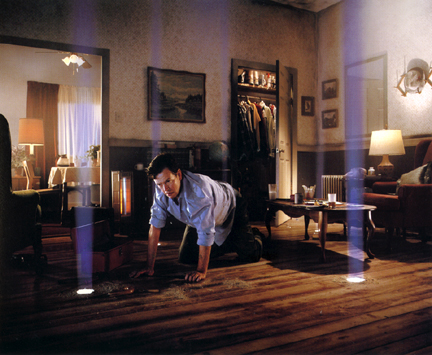
Upon first discovering Crewdsons work, I was particularly interested in the techniques used to construct his images. This is especially true in his collection of photographs in the "twilight" series. Crewdsons method is to build fabricated set-ups in constructed environments, often using lighting associated with the film industry. This gives his images an incredible sense of drama and an intriguing narrative emerges from his work.


The Twilight series addresses a number of issues often seen in Crewdsons work. Aside from his usual themes, Twilight also creates some interesting questions relating to suburbia and the "normality" we often associate with the domestic environment. His images are often shot indoors, however a strong sense of an almost artificial natural world emerges - Over saturated, bold greenery is placed inside the domestic living room, for example. We know this is out of place and doesn't fit however Crewdsons "characters" interact with the natural elements in a very familiar way.


This unnatural vs natural is an incredibly strong theme in the Twilight series. His images combine many opposites to question the reality of the shot - beauty vs horror, real vs surreal and familiar vs unknown. Even the familiar domestic landscape is challenged by the viewer seeing under the floorboards and into the unknown. The thing I truly love about Crewdsons images in the Twilight series are the questions they raise. I have an almost insatiable desire to know what is the story behind the shot. Why does the young girl look longingly into the school bus to the waving gentleman? Who is the woman in the flooded house and what has happened to her? The highly theatrical nature of the constructed film-set style environments would be engaging in most images, however Crewdson uses light in a such a sensitive way that only intensifies the drama within the frame. His work continues to be a great inspiration to me and is perfectly subtle look into surrealism and our desire to question our reality.


Periodicals 'God is in the Details'

Article about photographer michael Thompson, he does lots of work for beauty and fashion magazines. Thompson photographs celebrities such as model, Heidi Klum and actresses Gwyneth Paltrow, Milla Jovovich, Kate Hudson, Selma Blair and Julianne Moore. Quote from Thompson on his work... "There's nothing wrong with an out-of-focus, grainy picture, so many amazing images are like that..." "... you can have a beautifully lit, beautifullt techinical photo but if it doesn't have that feeling behind it, then its really nothing". Thompson has made images for beauty and fashion magazines and its a world where everything has to be perfect. From reading the article it becomes very clear that the more you search for perfection, you start to see the beauty in imperfections. Having celebrity status puts pressure on the person to be 'perfect' bu there is only so much they can do, where as a photographer, with the help of post production work can achieve the perfect image that the magazines want to promote. Professional Photographer, April 2011. 'God is in the Detail' by Joss Stone.
Social Networking - Books/own opinion I had some trouble finding information about social networks in the library, so i decided to give my own opinion about them. The top 3 most used social networking sites on the internet are Myspace, Twitter and the most popular of them all is Facebook. There are more than 500 millions users signed up to Facebook, 50% of them log on at any given day, the average user has over 130 friends and people spend over 700 billion mintues on facebook a month. More than 30 billion pieces of content shared each month. One of them is photographic images. One of the main features for Social Networks is Photo sharing, over 60 million photos are added each week, this makes photography one of the most important parts of creating a social networking profile. Using a social network not only lets you communicate with friends and family, but it is also used as an electronic photo album, it lets you upload almost any and every photograph you take with a camera. Now as the popularity of using social networking grows, the demand to upload more and more images grows also, now it seems that people have to upload images of anything an everything, such as holidays, weddings, birthdays, days out and just day to day life. From coming from an age of people sticking family photographs into albums, to entering a new age of uploading many images at a time and not worrying if the will be worn out with time. I have come to think of what the future holds for photograph albums in social networking sites and what new ways to store and view photographs will come in the future.

Sebastiano Salgado "Workers: an archaeology of the industrial age". (books)

Sebastiano Salgado was born in Brazil in 1944. After a short career as an economist in age of 29 he started working as a photojournalist and few years later moved to documentary photography. Salgado’s book was published in 1993 and presents final effect of seven years of traveling around the planet mainly to the “forgotten” places where world’s poorest fight for their existence. Our look is attracted by beauty and honesty of these photographs. They take us on a fascinating and true journey through perseverance, grace, dignity, devotion and endurance of working people. There is noticeable line dividing his work from typical photojournalism practice which main aim is to inform. We can see here Salgado’s sensibility and ability to identify himself with characters in photographs. Many times, during his travels, he “shared a bed” with them. Salgado clearly indicate one of the most important problems of first world civilization – its ignorance and brutality in striving to achieve its own goals; and building future on fundaments of poverty of third world. Although it is difficult not polemicize with Salgado. In dedication author says: “This book is an homage to workers, a farewell to a world of manual labour that is slowly disappearing and a tribute to those men and women who still work as they have for centuries”. He wrote these words just after second world fell into ruins. From perspective of nearly twenty years we can see that new millennium didn’t bring a change and poverty and manual labour spread even more widely across the world. Are we witnessing the situation where Fritz’s Lang vision became a true? Salgado also says: “The destiny of man and women is to create a new world, to reveal a new life, to remember that there exists a frontier for everything except dreams”. I think that in our world as it is in the eternal course of nature not all dreams and voices will be audible in creating a new future. Documentary film about Salgado (part one): http://www.youtube.com/watch?v=5X76jieUgTQ&feature=related

Friday, 25 March 2011

Edward Burtynsky - Manufactured Landscapes (book/web)


The Canadian photographer, Edward Burtynsky asks global questions about industrial costs on the natural world and how we are changing our planet. Working closely with several large companies, his images provoke feelings of wonder tinged with a sadness embedded deep within the destruction and ever-present changes taking place within the photographs.


A large section of his book is shot in China where the scale of the images intensifies. Burtynsky uses very small apertures (f45/f64) on a large format 4x5 camera for amazing detail and depth of field to capture everything in the field of view, for example warehouses half a kilometre in length. In both contextual and compositional terms, as here i think the two are divided, i believe his work sits somewhere between Peter Bialobrzeski's and Andreas Gursky's as the idea of transformation is present plus they also have tonal and vantage point similarities.

The image above is taken at the Three Gorges Dam on the in China. The largest h.e.p dam in the world will be the main source of power for the Shanghai District yet a total of 2 million homes including 3 entire cities have had to be "moved" for both it and the reservoir it creates. By moved, the Chinese government mean paying the locals to demolish their own homes and relocate locals to specially built cities tens of miles away. Personally, i think this is a great oxymoron to photograph, the push for clean power and sustainability is undermined by the human costs of moving.

The book - Manufactured Landscapes describes the series well. It is a very honest book without the slightest feeling of pretentiousness often found when ideas of globalisation and exploitation of natural materials arises. He's documents what he see's and this style reminds me of Winogrands images, showing the world for what it is with a vision for what it may become.

Click here for video talk on TED.com about Manufactured Landscapes.

Click here for website and to view his other books such as Oil

Copies, Codes and Patterns; Living in the Binary World (Web)

Joan Fontcuberta
Archive Noise (Googlegrams)


After viewing some of Joan's Googlegrams in the session I immediately wanted to learn more about them. I came across her artists statement for the project, which seems to contain most of the information on how the project was constructed and I found to be an excellent starting point:

Artist's Statement

Joan's statement explains the entire process in depth making it reasonably easy to understand. For the googlegrams, she used a photo mosaic freeware program, in which a large final image is produced from a collective of available photos in the directory, using the smaller images as if they were coloured cells and placing them in chromatic and density values. The software is used by many graphic designers, with their own directory of images available. However for the googlegrams, Joan has used Google for her directory of images:


"For the Googlegrams, however, the programme was connected to the Internet and used the search engine Google to locate thousands of images on the basis of search criteria determined by the user, normally images associated with one or several words. In the Abu Ghraib photograph, for example, the search engine was given the names of top officials, civilian contractors and enlisted soldiers cited in the ‘Final Report of the Independent Panel to Review DoD Detention Operations’ (August 2004) of the Schlesinger Panel, set up by the United States Congress to investigate the alleged abuses."


I suppose it doesn't really surprise me how easy it is to gain so much from the internet using simple searches because that's what it has become; a shared pool of information which no longer has much meaning of ownership. The information is no longer physical, and to some extent a vast quantity is false information. The internet has made it possible to share everything, and in some cases even the most private information and images are displayed for the internet community to view.

As immense as the internet's pool of information is, there is always the introduction of 'noise'. When using google to search, it is inevitable that the criteria will bring up certain connections which are not intended. Hence the project name 'Archive Noise'.


I find it fascinating how detailed the large images actually are, even though when you look close up there aren't really any defined lines. Even with the political connections and context, I think the images are beautiful. I find the process very interesting and just shows how vast and readily available the pool of information on the internet is to the public.

Wednesday, 23 March 2011

"In Conversation" - JH Engstrom at the National Media Museum

In Conversation - A meeting with JH Engstrom
National Media Museum, Bradford 22-03-11

http://www.nationalmediamuseum.org.uk/Events/FromBackHome.aspx

Upon hearing that both JH Engstrom and Anders Peterson, photographers that had collaborated on a project entitled, "From back home" were going to be talking about their exhibition in Bradford I was incredibly excited. When I first viewed the exhibition last year it had a profound effect on me - the work of Peterson in particular was very interesting. I found the exhibition truly inspiring and their lack of following photographic technical conventions (such as mixing black and white images with colour in the same collection) was refreshing to see. The chance to meet two such prolific and renowned artists was very exciting and I was interested to discover what they would discuss.

Prior to entering the talk, we were informed that Peterson would not be available to talk due to illness. This was somewhat disappointing as I had felt more of a connection to his work, however I was aware that he had mentored Engstrom, therefore he would be capable of informing us of some of Petersons methods and approaches. The theatre in which the talk was held was fairly small and intimate and there were only a few members of the public present so the whole talk was quite relaxed and informal.


Engstrom began by talking about his photographic career, his influences behind "from back home" and some personal issues that inform his approaches to photography. He then showed a series of images from a not-yet published book "Wells" centered around the birth of his twins. It was interesting to see a preview of some new work, as it was quite different to his previous projects. It seemed a lot more personal and ethereal, almost organic. Engstrom then showed the video piece he made about Petersons work and life and most importantly, their relationship as both master and protegee and also as friends.

Engstrom spoke about Peterson in a clearly incredibly sincere way. The two photographers are very close and most of the talk was centered around their relationship and the personal struggles with their work and approach. Engstrom was suprisingly open and honest about his own feeling towards his work - the doubt he feels and his desire to be recognised. It was inspirational to hear a photographer talk about himself in a sincere way, almost as if he was sharing his burdens and secrets. Although Peterson wasn't present, Engstrom was able to provide lots of information about him and his career. Although the talk was both refreshing and inspiring, Engstrom talked a lot about his personal life and his and Petersons emotional connections to thier images and it would have been nice to hear him talk about the production of the work and their different photographic approaches.
Below is an interesting article in which JH Engstrom discusses his new book, "Wells"

Tuesday, 22 March 2011

Salford Keys Review

Imperial War Museum North


Cecil Beaton - Tyneside Shipyards - Outside exhibitions


This work by the famous, late Cecil Beaton documents the dying ship building industry in one of Britain’s most important pre-war ports. The work also shows the positive effects the war had on this industry. The need for battleships meaning that the workforce almost doubled in only a few years. I think this is an interesting/positive take on a subject often conveyed so negatively through images such as McCullin’s and earlier Capa’s. I am by no means saying that The Second World War was a good event but i like to think there are opportunities in bad situations.

In terms of the exhibits themselves, I went expecting a usual gallery style showing but was surprised to find the 6 large scale prints outside the building and as I walk around them now the shadows and sunshine become part of the photographs, it is nice to be able to be amongst the images, pick how you want them to be viewed and see how the environment changes them. However, this might not be as enjoyable in the rain.


Gerry Judah - The Crusader 2010 - 3D Instillation


Although not a photograph, this 3D piece really caught my attention in the main exhibition space. From some angles it looked like a cross. Contrasting the holy symbol with an object of discord and the destruction that war brings. Personally, i believe that the vast majority of wars and conflicts have something to do with religion and differences in belief - I think this shown well in this composition. It’s form is quite sharp and broken which relates to the impacts of war yet it is the purest of toneless white which not only make it bold but bring in the idea of god and the greater being.

The Lowry

Harry Hammond - Halfway to Paradise - Iconic singer and band photography

Sometimes said to be the “founding father of music photography” Harry Hammond shows his work with bold, black and white portraits often with multiple catchlights and top-lit images. However, are these images really about music? Or are they more about the personalities, characters and our own understanding of the 1960’s celebrities in the images? The photography from around this time was starting to portray the ideas of the celebrity and what they were like ‘off the stage’ - could this of paved the way for the reality television and celebrity obsessed culture of today? V&A website