Tuesday, 8 March 2011

Photography Identity- Age: We Too Shall Grow Old


We Too Shall Grow Old- Natalie Kirk


In 1980s photographer John Willis visited nursing homes and the elderly people who reside there.


The images are black and white, ambiently lit. They look delicate, fragile, like the subjects.


Willis questions our perception of what it's like growing old in our contempory society. The work isn't intenet on speaking out against nursing homes, but it does raise the question that, while there is a genuine need for them and the services they provide, are they, we, doing enough to help? Does our society need to improve its means to properly care for our elderly, whether in a nursing home or not?


We have a responsibility to care for elderly yet it feels like society has forgotten those in need of our help and thier contributions to our society, sadly it seems easier for it to be that way but, it isn't right and it isn't fair.
Willis' goal for this work was to inspire people to act on behalf of the elderly, individually or on a larger scale. "If compassion and empathy for others is not enough to make us act then I suggest we remember that we too shall grow old."-John Willis

Photography identity and age: Web source


Trent Parke

One of Australia's most famous contemporary photographers, Trent Parke toys with the idea of both identity and age in his compositions in a less obvious way than the longer term members of Magnum. Although his photographs are breath taking in form because of the high contrast monochrome prints which often feature backlit subjects, i think his images contain a hidden undertone. Do his compositions contain any people at all? or are they merely silhouetted outlines which want us to create an identity for them? Can we tell the age of these people? Does the playful dive of the swimmer mean this person is young? This raises the question - Can identity, age, and personality really be captured in a photograph? Personally, i think we donate and stereotype perceptual identities onto such subjects in images and in turn make them more interesting to experience, objectify and create meaning from for ourselves. Is this the trait of a successful photographer? These people are mere figures, we look at them knowing only half or even nothing of what they see, where they are going or what they feel - yet we are left contemplating and imagining these very things. I believe a good photograph has elements left behind, waiting for the viewer to fill in the gaps.

Images from: Magnum Photos

Photography Identity and Race


Roshini Kempadoo

Sweetness and Light

Kempadoo’s work ‘Sweetness and Light’ was created in 1996-7. Being a Black woman at this time, it was difficult to gain exhibition space. She therefore became one of the 1st people to hold her exhibition online.


Looking at her work, I see a hierarchy of people in relation to wealth and jobs. Looking at this particular image ‘Head People 02’, i see a wall with people standing upon it with pillars taller than themselves. The wall seems to symbolize the growth in which these women have come. With 3 layers on to it (standing on the 3rd) it seems to show that they have traveled a substantial amount to get to where they are now. However, the women shown seem to be portrayed in a ‘mug shot’ style. This, to me, shows that they are still being documented and watched. The rulers that separate each women show a mathematical measure, again, showing how far they still have to go to reach ‘the top’ of the hierarchy. This can also be measured by the pillars in which they are near. This gives a representation again of how much work they have to put in to travel such a short distance.

If this image was created by a middle aged, middle class male, this image could be completely different. It seems that society believes that if one does not fit the ‘norm’ of society, then they have to ‘aim high’ and ‘work hard’. This is measured on job, wealth, area in which a person lives etc. If this woman was a homeowner in Great Britain who's job was paid rather well, this image would have hardly any impact.

Would it show the hard work and graft this person would have gone thorough?
Would they have even had to work hard for their job?

I believe that Kempadoo’s work is somewhat inspiring to believe that anything is possible if you work hard enough. To be just handed something gives one no sense of achievement or journey. Lessons haven't been learnt.

Sunday, 6 March 2011

Photography and Gender - Web

I had a little trouble finding relevant information on this subject, but i did find a few artists that i thought might be usefull.
Anthony Gayton Photography : http://www.anthonygayton.blogspot.com/
This is a Anthony Gayton's blog, here he has put his images of his photographic shoots and he has also written some text about his thoughts on the images.
Arnaud Delrue : http://www.delrue.fr/
I dont really know much about this artist but i think that it is relevant to the subject that i have researched.

Saturday, 5 March 2011

Photography Identity and Gender - Books

I didn't manage to find anything useful from the books, however here are a few links I thought were quite interesting. The photographers listed all seem to have one thing in common; daring to cross as many lines as they possibly can with photography and gender. They seem to suggest gender should not be seen as a boundary and it does not define our identity. We can form and change our identities, express them with the use of photography and writings. We can modify our gender without affecting our sex, and possibly - vice versa.


Del Lagrace Volcano
Statement
Del Lagrace describes himself as 'A gender abolitionist. A part time gender terrorist'.

http://www.dellagracevolcano.com/fiercefemmes.html#9

Diana Blok - See Through us
Biography
http://www.dianablok.com/see-through-us/index.html


'portraits and stories of gay women/men and transsexuals in Turkey'


Jill Posener - Erotica
Biography


http://www.jillposener.com/photoview.cfm?category=erotica


I think I respond to these photographers and to some degree the people portrayed in the images, because I admire their confidence in expressing their identities.


Monday, 28 February 2011

Photography and Race (books)


Identity
Identify, establish identity of; associate (oneself with); treat as identical. Identification, Identity, absolute sameness, individuality, personality.
The everyman English dictionary, DC Browning, 1990.

Race
Descendants of common ancestor; distinct variety, breed: noble birth; peculiar flavour; natural disposition. Suicide; diminution of population by restriction of birth rate.
The everyman English dictionary, DC Browning, 1990.

“The Ugandan child’s hand, in contrast with that of the missionary, looks like the claw of an emaciated bird or something found in an archaeological site.”

This image is by a photographer called Michael Wells he is based in Ilfracombe in North Devon. He used to work as a royal butler before entering a profession in photography. His style is very relaxing and calm.

In this image Wells has managed to capture the difference in race. when I first saw this image I immediately thought of race in history, with white people being more wealthy and black people being poor and used as slaves. And it seems that things are not much different these days there is still no equality people are still living in bad conditions.

The difference in race means this poor African person lives a poor and starving life and the white person a healthy looking person. there is no need for faces in this imge the hands say it all you tell a lot about people from their hands usually something like a profession, but this image shows us a much bigger picture, from the image of just a hand you can see this person is malnutritioned and poor.

I like this style of photography it keeps the image calm, had the photographer used their faces in this image it may have reached out to the audiences emotions which Wells may not have wanted them to connnect with as an audience.

The Photography Book. Phaidon 1997.

Sunday, 27 February 2011

Photography Identity and Class - Journals

Colin Jones was a ballet performer but abandoned this profession when he accidentally discovered a love of photography. He saw photography as a way to challenge society's ideas and politcal status. His instinct was always to provoke, to question, to confront, even with his photography.
While he was still on tour with the Royal Ballet in Sydney, his passion for photography became more important and he was inspired by the many different people he came in to contact with. This influenced him and eventually directed him on to his career path of taking images.


"My first job, I didn't actually know what the f*** I was doing," he remembers. "They sent me to photograph J Paul Getty at his house near Guildford. I didn't know anything about lighting and it was absolutely black, this place. I just about saved it, but they didn't complain. I think i shot more covers for the Observer than any photographer. Well, I know I did. I went all over."


Intrigued by the problems of the disenfranchised underclass, he developed an interest of documenting minority groups. One of his major and famous projects was the Black House series. This lasted five years in which he spent periods of time with young Carribbean men who lived in Islington north London. The experience was often dangerous and intimidating but highlighted a section of British society which was often hidden from the majority of the British public.


The Black House, 1976

"Very few other white people went inside the house and at the beginning I was regard with suspicion, as the enermy. I often felt frightened. They didn't physically threaten me -they didn't need to - but you could feel the vibes. These were kids who had just come out of Borstal. They'd stare at you and be very moody. They were a lot of mental health problems and some of them woud get very depressed," he has said of the experience.


" I learned a lot. I learned what the people on the street don't know - the police brutality and the planting of drugs. The police... used to give these kids a terrible time.

"Some of my mates (from the house) are in prison now. I'm still in contact with some of them, but i try to keep away from them really, because they are always so demanding. They always want something. It was all right when you've got money, because they are always after money."


Jones' career in photography brought him into contact with many different social classes. By documenting projects of the lower social class this brought recognision of the higher classes and enabled him to socialise within all groups of society.
He was right in the middle of things during the cultural revolution of the 1960's and 70's. Famous aquaintences at the time included many music stars such as Mick Jagger, Marianne Faithfull and Eric Clapton. He also toured with the band The Who.


The Who pictured on the cover of the Observer Magazine 20th March 1966


Professional Photographer

Photography Identity and Age: Web

I originally set the task to do Athens for my research resource, but after spending hours looking through different sources on Athens I found it difficult to find and relevant sources. So I decided to change to using the web, as while using this to find artist to search in Athens I found an artist work I really did like and was relevant to the subject title.

Oliver Tudoras

Tudoras originally work as a care working in Linz, Austria. His work let him meet people of an older generation. He loved his job, he would listen to people tell him interesting stories of their past. This really shows in his work which he later started. His portraits, and many of his other works too, are very strong black and white images. They may not be technically brilliant but they are still beautiful images in their own rights.

Untitled.

This is an image of Tudoras that I love, even though it is not greatly focused (which could of been on purpose) I still think the composite works well. This image really does speak a thousand words and makes you think about the meaning and discussion behind the image. The original display of this image is not as a double piece like this (I could not copy the image from his web site) but these too images together work well together and help tell a story of the lose this man might have gone through. It really does depict the trouble an elderly person may go through, with losing family and friends.


Untitled.


This is another image I am fond of. It again like many of this other is not technically brilliant but it does draw you in and make you think about this man's thoughts. This describes so well how the older generations talk about the past and how they use to be. This image shows an elderly man in front of an image of a younger gentleman which may be him, Tudoras could of been in many discussions with this man about his time in a war.


Links:


Music Video by Aquarian Age - Time (This video has many of Tudoras images in)

Saturday, 26 February 2011

Photography and Race - Athens resource

30 years documenting the American Ghetto -The work of Camilio Jose Vergara

Chilean born documentary photographer Camilio Jose Vergaras has become a key figure in documenting changes to the landscape and architecture of American ghettos. His work spans over three decades and Vergara won the acclaimed MacArthur Genius award in 2002, which helped fund his travels to many of Americas most economically deprived and segregated ghettos and communities.


Vergaras images capture the changes both sociologically and physically in urban environments. His work is concerned with deterioration, dysfunction and urban issues and his images also capture a sense of religion and American values. Vergara has an almost methodical approach to photographic documentation by researching his chosen subjects and systematically returning to photograph and document them over time.


http://www.nytimes.com/2009/05/29/arts/design/29verg.html http://www.americansuburbx.com/2009/03/news-flip-side-of-suburbia.html http://thisplacemattered.tumblr.com/

Images from the series "American Ruins" particularly interested me. Here Vergara uses shots of architecture in various stages of decay and deterioration to show the plight of people living in the ghetto. His images speak of the desperation and the hopelessness of a generation of people struggling to live in areas of vast economic hardship. Vergaras approach to his image making - returning numerous times to reshoot the same location shows the true price of fulfilling the America dream. The "melting pot" of a true multicultural society doesn't exist here - these citizens feel rejected by the white American community and are forced to live on the outskirts in absolute poverty.

"Bricks, signs, trees and buildings spoke more eloquently than peoples faces" Vegara, CJ - http://invinciblecities.camden.rutgers.edu/intro.html

Vergaras dedication to recording the plight of thousands of civilians in Americas largest minority groups and his view that the landscape can speak strongly about the changes felt by the whole community,give his work a startling sense of truth. The personalities of the people living this life are not represented in any way by Vergara - to him, the context and environment is far more important in depicting the dysfunction and deterioration of some of Americas largest ghettos. His work continues to this day and only through truthful depiction can we begin to understand the hard,uncompromising life of thousands of America's "unwanted population"

Link to Athens article -
http://vnweb.hwwilsonweb.com/hww/results/getResults.jhtml?_DARGS=/hww/results/results_common.jhtml.35

Monday, 21 February 2011

Public and Domestic Incident

When first researcing Photography and Domestic Incident I came across Rankins work with womens aid. The ACT campaign comprised of nine female celebrities made up to look like victims of domestic abuse. The campaign recieved substantial media attention and went on to win a number of honours in the advertising industry.


This subject then lead me on to the work on Nan Goldin.

Nan Goldin describes her photography as a "visual diary". She has stated - "These are my friends, these are my family, this is myself. There is no separation between me and what I photograph".


The self portrait "Nan one month after being battered" was taken to prevent Goldin from forgetting the damage caused by her boyfriends violence.


In one of her better known images, Nan and Brian in Bed NYC 1983, the scene is suffused with a crepscular orange glow that palpably captures the mood of a dying relationship. Brian, her lover at the time, sits naked on the edge of the bed, smoking a cigarette; Goldin lies behind him, her face a mixture of affection and vulnerability. The relationship ended in a storm of abusive violence, as the next image, Nan One Month After Being Battered NYC 1984 dramatically showed, with Goldins scarlet lipstick vividly echoing the blood in her injured eye.


My final images are by a lesser know young photographer named Chris Buley.


The images depict the effects domestic abuse both mental and physical can have on a child.


These are beautiful black and whites which speak for themselves.


Sunday, 20 February 2011

Photography identity and age Books

Toledano, Phillip. Days with My Father. Auckland, N.Z.: PQ Blackwell, 2010. Print
http://www.dayswithmyfather.com/


Finding Philip Toledano's work was a very emotional experience for me. Touching on the issues of an elderly parent who is dying, for me felt very brave and very intimate. In this book, Toledano is going through the process of saying goodbye to his father who has short term memory loss but also about finding a new relationship in which he is also celebrating the strengths of his father that he may not have been able to fully appreciate had they not ended up in this experience together.
Having had a very similar experience with my own father, supporting him for 3 years before he died of cancer, I was deeply touched by this work. He definitely caught the emotion one feels in this situation in which I could relate to.
Ageing and death is something we will all face and the issues surrounding this are hard to express.
A very real, emotional struggle that many people have to go through when parents age and roles change. 
For his father, is seems that the reality of his own ageing is a painful experience which shows that he needs his son not only to support him in daily care, and the issues of his illness but also,to support him emotionally.Here the roles do change and the love given to Toledano as a child by his parents bonds his responsibility to his father.
The humour and sadness of these images show the love between a father and son and the realisation of mortality for both individuals. The muted, blueish green colours work together with each image to support the feel of the work. The light in these images is truly beautiful and natural and captures the essence of the emotion.
Personally, this work gives me respect for Toledano for the braveness to enter into this work and also, photography itself as a powerful medium which allows us to step into truly private and beautiful moments which are essentially, as Toledano expresses, about love which is after all, universal.

Tuesday, 15 February 2011

Photography as identification

-book stock

In the book “Applied Police and Fire Photography by Raymond P. Siljander, Siljander talks about the Identification Photography, about where the roots of mug shots and identification photography come from and what position they had in the 80s when the book was first published.

In history , law enforcement authorities around the world have searched for a reliable means of identifying criminals. It took until the early 19th century to bring criminal identification to a reliable and scientific level.
Not long after the inception of photography, the police started to use it to take identification photographs of people after they were charged. Commonly, such images are called “mug shots”
Photographs serve a useful purpose in the area of criminal identification, even though they are some well known limitation. Photography was, and still is, simply one of several identification methods.
Even though police took “mug shots” for years, photography was preceded by various other forms of identification methods, with different approaches, depending on time, place, culture and the effectiveness of the method.
It is very interesting to see that some of the oldest methods are still being used today in some form. For example, more then 2000 years ago, the ancient Chinese used finger prints as a approximate form of identification, and finger prints are still used today. Some ancients cultures used methods of scarification while others used tattooing. Siljander says that those methods are also still used today in some places and in some cultures. But the result of scarification and tattooing can be manipulated just as a cattle brand can be altered with a running iron.
Personal descriptions of a person have no doubt been used since the beginning of time. This is still used today even though, like other methods, the accuracy cannot be relied upon.

When photography was effectually developed as a science, police began to use it as a tool for identification purposes. It did not take them long to realise that both a frontal and profile view was the preferred format.
In Siljander's opinion, identification photographs serve a useful purpose and will no doubt continue to be used for a very long time. There will probably never come a time when they are not used, but he says they do have their limitations. It has been said that everone has a double, and it is very true that people can bear a strong resemblance to another person. Another shortcoming is that the appearance of people changes over time, some very significantly. Here is an example of the same person; the second image is taken 22 years after the first one.


The history of identification methods is long and clearly hasn't finished yet. Only time will tell what happens next. “Mug shots” will probably be around for a long time to come.

In my opinion, the book is very good but out of time. Siljander explains the history of mug shots quite simply. The book was published in the 80s and therefore there is nothing about digital photophaphy. Even criminal and identification photography changed technically with the introduction of digital cameras. He talks about the photography as if it were the photography of today, whereas it would be a better description of the photography in the 80s. It is slightly confusing, because there are a few things that have changed over the time.

Monday, 14 February 2011

Photography as Identification: Periodicals


Gandee Vasan- Dogs Days

AG Journal: Winter 2007/Isuue 46/Page 31


Identification is usually associated with humans, but what happened when this is replaced with animals? Does it still contain the same elements?

Vasan's work 'Dogs Days' captures 77 different portraits of dogs. From Dalmatians to Schnauzer's, each dog's characteristics and personalities are captured. Each shot is taken in a rather regimental framing, almost PassPort like.
This style of photography seems as though it could act as a form of doggy identification. The straight forward shoulder height framing of the dogs makes them all comparable, therefore making it easy to show differences and similarities between each dog. Each dog has different features and dimensions. By photographing the dogs straight on and also to the side, one can see all of these at different angles. This is almost the same as the technique used to photograph humans in a Mug Shot style.

I really enjoyed Vasan's work as it allowed a different element to be brought to this style of photography. Its not often that animals are photographed which made me wonder why choose dogs. Was this because its said that a dog has its own personality? or that dog often looks like its owner? It is also interesting that he chose to photograph them in the way that he did. He could easily photograph them with their owner at home, but he has totally taken them out of their environment, making them un-identifiable from anything but their breed.
Although i liked this piece of work, i felt that it was'nt unique as Vasan also did a project on Cats. This was shot in exactly the same way. This then totally takes the objective out and makes each dog or cat exactly the same... a pet.

Photography As A Surveillance Device

As I had difficulty finding books which specifically included references to the practical uses of surveillance photography I decided to look into photographs that had the same visual characteristics as surveillance pictures and connected to the idea of being watched and observed in our society.

One work which I found was Phillip - Lorca diCorcia's series Head which has images obtained by concealing a camera and flash on a scaffolding in New York. The flash was programmed to go off each time someone passed by and then diCorcia would take the image.


 Photograph from The Photograph As Contemporary Art, Charlotte Cotton p20


Another work I looked at was City by Beat Streuli which has a similar idea behind it except that these images are taken in daylight with a very long lens usually including more of the subjects body. To me these images have a more personal and voyeuristic feel than the other series as the bright daylight and the other people out of focus and blurred in the frame make them seem like photographs from a private investigator.

Beat Streuli, City


http://www.sparknotes.com/philosophy/disciplinepunish/section7.rhtml


Typologies (source-books)

‘In photography there are no unexplained shadows!’ August Sander

The work and projects in this book are some of the most fascinating collection of photographs to look at. Looking through feels like trying to understand an individual’s idea of a human encyclopedia.
Using Typology with people is to divide us by culture, race and classification, the list could be endless. It’s to strip people into fragments and details that separate them from each other. In a way it’s a stereotypical way of thinking in its extreme.
Dwarves 1913

The reason I find the book so interesting is not only because of the incredible quality of the photogrphs but the whole idea behind them. There’s an interesting quote that accompanies the images in ‘People of the 20th Century’ where Sanders has written ‘It moves from the people of the soil to the highest point of culture and down to the idiot in the finest gradations’. I have looked over and over these images of ‘the philosipher’, ‘progressive intellect’ and ‘two couples’ that are in this set and I still can't understand how he has justified the interest in each person and the connections he has made. I can only try to understand it by seeing it as the psychology of his time and social understanding.
I find some images hard to look at, as they seem like catching a deer in the headlights. They feel like awkward portraits not only to look at, but also for the subject in the photograph. As if they are being pointed at and alienated behind the lens. Sanders doesn’t seem to treat his subjects as individuals but as a network of people.
Young farmers 1914
(image taken from
http://experimentiv.files.wordpress.com/2010/05/august-sander-dwarfs.jpg)


Even though I may not agree with , or understand the true meaing behind this work, I can appreciate it's culturally significant and an important piece of history. To define and create Groupee’s was seen as important and useful around the 19th century and Sanders work has built a comprehensive map of his own.


Famous Female Faces; Photography as evidence of domestic and public incidenthttp://womensaid.org

Famous Female Faces; Photography as evidence of domestic and public incident
Natalie Kirk


In 2007 photographer Rankin worked alongside the charity Women's Aid in a campaign against domestic violence. ACT Campaign.


Rankin shot images of famous female faces made up to show the effects of domestic violence. The campaign wanted to emphasise the fact that domestic violence can affect every woman no matter her age or situation. The images depict the affects of a violent relationship.


The fact that celebrities are used makes you instantly engage with the image, you recognise the face - "Oh it's Mequita from T4"- You take notice and it gets people talking -"Have you seen that photo of Fern Britton with a black eye? It's for that domestic violence campaign"- The power of celebrity will get people recognising and talking about your campaign, which is of course what you want, you want the attention and the hype for your cause. You want people to remember. But...does the fact that it is a celebrity somehow detract from the harsh reality of the affects of domestic abuse? Are the images somehow easier to look at because really you know it's not real, it's make up, this is what could happen to someone in an abusive relationship not what has happened to this person.
If it was a stranger in the images, someone who was a victim, someone you didn't recognise, would people talk about them in the same way? Would the images be harder to look at or more shocking because they're real, this is what has happened to someone, this person has suffered. Would they get the same kind of attention or be remembered in the same way?
I feel that the campaign is for an amazingly worth while cause and raising awarness of domestic abuse is a much needed education for our society, using the help of celebrities in the campaign deffinately catches people's attention easily. However, I can't decide whether or not it slightly detracts from the severity of the situation, if it somehow demeans the victims? At the end of the day the celebrities can wipe off all the make up, it's not a reallity for them.
The campaign wanted to raise awarness that domestic abuse is going on all around us but it also hopes to encourage victims to come forward and talk. As a victim, would you be more inspired by a celebrity putting on make up depicting your experiences or, by a real victim having the courage to come formard herself?

'Surveilance' Articles via Athens

An interesting and very relevant exhibition at London's Tate modern last year was Exposed: Voyeurism, surveillance and the camera.
Initially, Shai kremer who was part of the exhibition,  stood out for me using the beauty of photography yet still utilising surveillance to address societal, political and military issues surrounding the battle for territorial dominance in Israel. In Infected landscape, The beauty of his landscape images enticing you to look and then as the photographer suggests follow up with a rhetorical punch in the face!


Another interesting piece of work is Jonathan Olley (Castles of Ulster) in which British military structures used to maintain control over northern Ireland are photographically preserved before their removal as part of the 1998 good Friday agreement.


Artists using surveillance in this way, interest me for the notion of subject becoming the viewer. At one point these objects were the tools to control and maintain control or one could say, Power. The control and power now becomes in the hands of the viewer.
The distance between subject and viewer seems to be a critical element. The closer we get, the more voyeuristic the experience becomes for photographer and viewer.
Schuman uses the short story from allan Poe. In this, the protagonist explores feelings of being totally absorbed in contemplation over the idea of observation of a gentleman he doesn't know.


The seduction of surveillance can easily lean towards voyeurism: the personal involvement is the critical aspect as Jill Miller explores in her work
From January - March 2007 San Francisco-based artist Jill Miller trained with a licensed private investigator. She worked on real cases, learning various components of the profession, from video surveillance to location stake-outs to note-taking methodology. Miller began this project out of her interest in the ways that the legal system protects (or challenges) an individual's right to privacy. Driven by this curiosity, she learned how to conduct surveillance within the legal limits of the law. Once familiar with the field, Miller executed her own plans for surveillance under the advisement of the private investigator. Only this time, instead of working on randomly assigned cases, Miller turned an eye onto the art world itself, spending 6 months undercover doing surveillance on some of the San Francisco art world's most elusive community: art collectors. Miller estimates she did surveillance on 10 houses, focusing specifically on 5 of them.


Schuman, Aaron. "Exposed: Voyeurism, Surveillance and the Camera." Aperture Winter 2010: 14-15. Art Full Text. Web. 14 Feb. 2011.


Riches, Harriet. "THE ART OF SURVEILLANCE." Afterimage Sept.-Oct. 2010: 26+. General OneFile. Web. 14 Feb. 2011.


Howarth, Sophie, Anton Corbijn, Chris Verene, Shizuka Yokomizo, Christian Frei, Sophie Ristelhueber, and Jonathan Olley. "What are you Looking at?." Tate Etc. Summer 2010: 70-81. Art Full Text. Web. 14 Feb. 2011.


http://www.jonathanolley.com/pages/imagegroup.public.intro.php?igId=77


http://www.tate.org.uk/modern/exhibitions/exposure/default.shtm


BaquĆ©, Dominique. "Vrai, faux, faux-semblants." Art Press June 2010: 90-1. Art Full Text. Web. 14 Feb. 2011.


Jill Miller


http://www.jillmiller.net/collectors.htm


Photography and Typologies

Typology is the study of classification and types. This can range from the Victorian studies on ear shapes and sizes to the studies that the Bechers did on grain silos and factories.

Typology has always been important, even today. If a new species of animal is discovered, it is classifed straight away to determine which animal family it belongs to. When a new baby is born, it is weighed and measured to see if it is an average size. Typology started out mainly to record and classify criminals and create an average. The Victorians seemed to think that by overlaying a series of images of criminals that had committed a certain crime, they could determine what that type of criminal would look like. They could give themsleves an average. This sounds slightly farfetched to us today, because we know better than to think that only certain people commit certain crimes. However, i came across an article recently that showed that some people think that this idea of an average is still relevant today.

In Thursday 10th Feb's issue of 'The Sun' newspaper there was an article that showed more than 30 faces of women from around the world. Photographs had been taken of over 100 women in different cities around the world and overlayes, depending on what country they came from. The aim of this was to create an average woman from each country. It seems to suggest that there are women that look like the countries averages somewhere in the world. I find this idea a bit odd if I am honest, mainly because we are so quick to dismiss the Victorian ideas of creating an average criminal and yet we think that this is believable, even though it is the same principle.

We are so quick to dismiss ideas that were from before our time and so quick to believe ideas that are around now, even if they are exactly the same.

Photography as Identification - Books

Immediate thoughts on Identification bring only shape, form and pattern, rather than character. I think of identifying a human, with recognisable features and lines, not of a person with personality and hobbies. A cold view of this subject however necessary none the less.

Thomas Ruff – ‘Other Portraits’

Ruff’s ‘Other Portraits’ are in somewhat of a similar response to Identification to that of myself. Superimposing two of his portraits and then using the base of Andy Warhol’s ‘Most wanted criminals’, he then took a photograph of the face construct and printed.


 His response is that of multiple images, being impossible to depict a personality or fix an identity. He uses a series of portraits symbolising the fact that there are millions of people, identifying one is no important than the other.
‘The portraits are about each individual and at the same time about all individuals’. 


There is a very reliable style to his portraits. Common lighting and poise, same facial expressions and background. Almost exactly like passport photographs; The most commonly widespread form of identification in our everyday lives, these portraits are depicted straight from the criminal identification photographs as well as common passports.

Articles Via Athens 'Photography As Identification'


Photography is one of the most reliable forms of identification. Most formal forms of identification tend to be a passport or a licence of some sort, but lots of photographs have ways of making us identify somebody without it being the same old passport photo style with boring lighting and same focal length.

These two images we find more memorable as this is what has been showed to us more often.
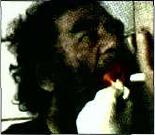
The photograph of Saddam Hussein is memorable to us as this is when he was captured and this is what was shown to us on the news.. We didn’t get to see the mug shot of him which is how most people remember other criminal such as Al Capone.

The mug shot of Michael Jackson is one of many similar shots that have documented the surgical changes he has made to his appearance. They have the typical style of the ‘mug shot’ the boring lighting and the size. But using Michael Jackson as an example are they true proof of Identity? This man has changed his face that much that he doesn’t resemble what he used to look like. So what’s to say that they are a reliable type of identification?

http://vnweb.hwwilsonweb.com/hww/results/external_link_maincontentframe.jhtml?_DARGS=/hww/results/results_common.jhtml.44