Showing posts with label Bec Boyce. Show all posts

Tuesday, 24 April 2012

Children and Partners (Family) Web


Dad on Bed, 1985 Larry Sultan© Larry Sultan.


"Photography is there to construct the idea of us as a great family and we go on vacations and take these pictures and then we look at them later and we say, 'Isn't this a great family?' So photography is instrumental in creating family not only as a memento, a souvenir, but also a kind of mythology." (Larry Sultan)


Larry Sultan often takes photographs from home. he shoots his mother and father the most in their comfortable middle class home, capturing their 'perfect' family life. but is it really the 'perfect' family life? this image indicates otherwise; we can see the relationship between Sultan and his family straight away. We get the feeling and understanding between the family. This image creates a narrative - what this image says to me, is possibly the dad got sick of waiting for the image to be taken and just gone back to watching TV. His mother, however, is more patient. As Sultan's dad was a retired lawyer and in those days photography was deemed as not a real job, it is almost like his father didn't take Sultan's job too seriously. 

I personally love these images, the colours really make them. it provokes questions and whether they are fully staged or not, it leads us to create our own narratives about the image. 


References:


BBC - Photography - Genius of Photography - Gallery - Larry Sultan. 2012. BBC - Photography - Genius of Photography - Gallery - Larry Sultan. [ONLINE] Available at: http://www.bbc.co.uk/photography/genius/gallery/sultan.shtml. [Accessed 24 April 2012].

Larry Sultan: The king of colour photography - Features - Art - The Independent . 2012. Larry Sultan: The king of colour photography - Features - Art - The Independent . [ONLINE] Available at: http://www.independent.co.uk/arts-entertainment/art/features/larry-sultan-the-king-of-colour-photography-2043204.html. [Accessed 24 April 2012].

Landscape


Ingrid Pollard (British, b.1953, Guyana). From the series Pastoral Interlude. 1987. Gelatin silver print coloured by hand. © Ingrid Pollard.

Ingrid Pollard’s ‘Pastoral Interlude’ explores the experience of Black people living in the English countryside. Steeped in the heritage of Wordsworth and the Romantic poets, her photographs explore the beauty of the English landscape and coastline, alongside the memories hidden within England’s history and its relationship to Africa and the Caribbean. Her interest in the layers of history is echoed in her use of 19th century photographic techniques.

“…it’s as if the Black experience is only lived within an urban environment. I though I liked the Lake District where I wandered lonely as a Black face in a sea of white. A visit to the countryside is always accompanied by a feeling of unease, dread….” Ingrid Pollard


Still Life - Traditional

Still life photographs can be something so excellent, that is everyday, that is things you often miss during your daily routine, and it can also be something you stage. Like, how you stage your cup of tea next to your plate of toast, or a flower vase next to the window. one of my favourite examples of traditional still life photography is the work by Josef Sudek. .


JOSEF SUDEK AT PHOTOGRAPHY-NOW. 2012. JOSEF SUDEK AT PHOTOGRAPHY-NOW. [ONLINE] Available at: http://www.photography-now.net/josef_sudek/portfolio1.html. [Accessed 24 April 2012].

Sudek’s still lifes, often rejected by photographic critics at the time, tend to feature limited tonal scales and are heavily involved with mystery and darkness. These mysterious images are powerfully personal explorations of himself, his self-examination coming from a philosophy shared by many painters of his era that symbolic form equates with inner emotions.
This thoughtful and isolated nature led to many of his still life images being shot from his studio window in Prague, using the window as a backdrop, often through a curtain of ice, dew or rain drops acting to distort the barrier between the outside world his own; and as a method of framing his chosen objects. Sudek was particularly interested in the refraction of light through glass objects and so his studio window served him well in his studies.


the body as an aesthetic object.

what makes a body 'aesthetic'? The abject body.

Vile Bodies: Photography and the Crisis of Looking, Chris Townsend, Prestel, 1998

Townsend , C, 1998. Vile Bodies: Photography and the Crisis of Looking (A Channel Four book) [Paperback]. 5th ed. England : Prestel; illustrated edition edition.


in this book are images by Joel-Peter Witkin. 


Witkin's work is very dark, his images provoke and startle. his work focus' on 'freaks' and 'deformed people' other themes in his work includes death and corpses. 

here are some examples.


METAL ON METAL: Joel Peter Witkin's transgressive photographic art. 2012. METAL ON METAL: Joel Peter Witkin's transgressive photographic art. [ONLINE] Available at: http://metalonmetalblog.blogspot.co.uk/2010/07/joel-peter-witkins-transgressive.html. [Accessed 24 April 2012].


the kiss.


Reminiscent of portrait as a vanity. 


i find these photographs controversial to look at and not what we would class as normal. in our society, we turn our noses up at the 'ugly' yet we are still so intrigued with death.There is nothing more fascinating death because we all have death in common, yet it is a mystery to us all.  It's an uncertainty and a real loss of innocence when we become aware of death.

Installation.


Bill Viola


Bill Viola is a formalist who has developed a distinctive visual vocabulary to investigate the most primal human emotions. Major exhibitions of Viola's work have been held throughout Europe and North America, including a 1987 retrospective at The Museum of Modern Art.


 Slowly Turning Narrative. 1992 is a piece located in the center of a large, darkened room with an oversize screen that slowly rotates on a vertical axis. One side of the screen is mirrored; the other is matte. Two video projectors face the screen from opposite sides of the room. One projects a black-and-white video of a man's face seen in close-up, in harsh light, appearing distracted and at times strained. The other projects a series of color scenes of young children moving by on a carousel, a house on fire, a carnival at night,and kids playing with fireworks--that are characterized by continuous motion and turbulent light and color. The black-and-white imagery is accompanied by the sound of a voice rhythmically chanting a long list of phrases descriptive of states of being and individual actions, the color images by the ambient sounds associated with each scene.
As the screen rotates, its angle in relation to each projector alternately narrows and widens, warping the projected beams and spilling images onto the surrounding walls. The mirrored side of the screen sends distorted reflections--indistinct, gossamer forms--cascading over every surface in the room. In addition, viewers see images of themselves as well as the room around them reflected in the mirror as the screen revolves.

‘Slowly Turning Narrative’ is concerned with the enclosing nature of the self-image and potentially infinite (and therefore unattainable) states of being, all revolving around the still center of the self.

 The room, and everyone in it, becomes a continually shifting projection screen, with images and reflections. The entire space becomes an interior for the revelations of a constantly turning mind absorbed with it.

MoMA | The Collection | Bill Viola. (American, born 1951). 2012. MoMA | The Collection | Bill Viola. (American, born 1951). [ONLINE] Available at: http://www.moma.org/collection/artist.php?artist_id=7898. [Accessed 24 April 2012].

I feel the most interesting part of this piece is,  as an Installation piece, it can be described as a 4 dimensional world where height, width, depth and time are the main components. Each viewer experiences the work in different ways and because of this, this creates new pieces of art within the actual work. I would absolutely love to experience this piece for myself.


Photography and Surveillance, web


Pronunciation:/səˈveɪl(ə)ns, -ˈveɪəns/noun[mass noun]close observation, especially of a suspected spy or criminal:he found himself put under surveillance by British military intelligence
When I think of surveillance, I think of CCTV and being watched - being watched without be even knowing. some could say it is an invasion of privacy. but if you think about it, how many photographers take photos of people who are too oblivious to notice? especially when it comes to street photography. street photography to some people is the photographing and oblivious people which are the subject which is then documented with a camera and lens.


Cornell Capa © International Center of Photography/Magnum PhotosMagnumphotos. 2012. Magnumphotos. [ONLINE] Available at: http://www.magnumphotos.com/C.aspx?VP3=ViewBox_VPage&VBID=2K1HZOF58JHDX&IT=ZoomImage01_VForm&IID=2K7O3RMI9V6&PN=51&CT=Search. [Accessed 24 March 2012]

take this image for example. How many people on this image do you think was even aware that this photograph had been taken by Cornell Capa? and out of the ones that do, how many people gave consent for the photograph to be used?


and again with this image by Bruno Barbey:


Magnumphotos. 2012. Magnumphotos. [ONLINE] Available at: http://www.magnumphotos.com/C.aspx?VP3=ViewBox_VPage&VBID=2K1HZOF586WM5&IT=ZoomImage01_VForm&IID=2TYRYD0K1AM7&PN=200&CT=Search. [Accessed 24 April 2012].

The subjects these images are both of passers by unaware of the camera, the idea of the subject feeling like they are being watched causes a strange feeling to the image. Conjures up many questions such as "who are these people?" "where are they going?" as it is just a snapshot, we don't get enough information, hence the questions it provokes. 


Identity


book stock + web.


Identity [aɪˈdɛntɪtɪ]
n pl -ties
1. the state of having unique identifying characteristics held by no other person or thing
2. the individual characteristics by which a person or thing is recognized

identity - definition of identity by the Free Online Dictionary, Thesaurus and Encyclopedia.. 2012. identity - definition of identity by the Free Online Dictionary, Thesaurus and Encyclopedia.. [ONLINE] Available at:http://www.thefreedictionary.com/identity. [Accessed 4 April 2012].

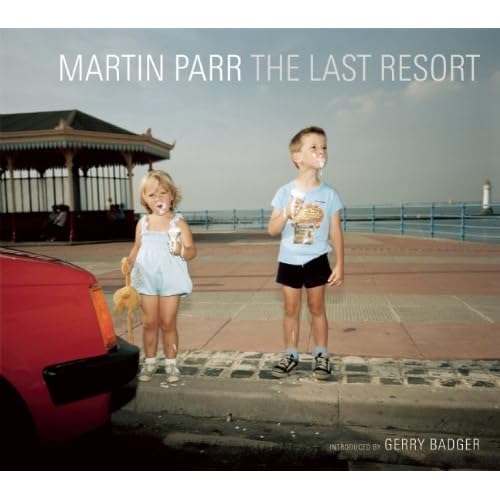
I really love photography when the personality is bursting through someone’s work. My favourite example of this has got to be Martin Parr. Martin Parr was born 23 May 1952 and is a British documentary photographer. He is also a  photojournalist and photobook collector. He is known for his photographic projects that take a critical look at aspects of modern life, in particular provincial and suburban life in England. He is a member of Magnum Photos.

In the majority of Parr’s work, he does not hold back when trying to capture the ‘real’ Britain that we live in. his images are shameless and absolutely fantastic.

I have look at his book ‘Last Resort’ to evidence my thoughts.


Parr, M, 2009. The Last Resort. 4th ed. England : Dewi Lewis Publishing


In this book, Parr viewed the decaying holiday resort of New Brighton and its holidaymakers in a way that was new, unique and deeply disturbing. And he did so in colour, something which at the time was seen as revolutionary for documentary work.


I’m not too sure if it is for me to say, but us Britain’s are awful. Soon as the sun comes out, everyone strips off, has no shame despite what size you are. We are hardly a reserved bunch. And the way Martin Parr has captured this whole series is fantastic.


The image above of a man with the most striking tan lines you have ever seen. The way Parr’s photographs are so extra saturated really extenuates this and I don’t think this images or the whole book would have worked without this method of working. and because Parr's way of working is so iconic, this gives him such identity. 


Thursday, 8 March 2012

Social Networking and Sharing


Is it a good or bad thing?

Since social networking, the way we have shared and view our photographic images has changed dramatically.  It has shifted the focus from a print to a visual image which then may never be printed – just stored electronically and possibly forgotten about.
Reasons why we moved and focused more on sharing images via social networking may be because;
It’s cheaper.
It’s easier.
It’s more convenient/ so accessible.

However, because of this, people have become narcissistic and far more interested in themselves than ever before. As sharing on websites such as Flickr, Facebook and blogs is free and accessible to pretty much everybody. We can upload mounds and mounds of images due to the convenience of digital cameras these days.
Also, people have become almost obsessed with taking images of themselves.  Which is down to social networking. Using social networking, people can change the way people even portray themselves.

Take Jennifer Ringley for example:


Jennifer Ringley, of the JenniCam experiment.

JenniCAM - Last Week at Jenni's Place. 2012. JenniCAM - Last Week at Jenni's Place. [ONLINE] Available at: http://www.arttech.ab.ca/pbrown/jenni/jenni.html. [Accessed 05 March 2012]


For seven years, Jennifer took images of herself on a webcam. At the time, webcams were new and this experiment was a first of its kind. It attracted a large audience – mainly strangers.  The images were just of herself, in day to day life. Mundane images really, but as people we have always been interested in other people’s lives – it’s almost like escapism from peoples own lives.

Which is a scary concept really. Putting images up of yourself available to anyone makes you a target and exposed to possibly stalkers. You can never know how safe you’re being online. – all because of internet personas being built up of images and online diaries. 

Another negative of online sharing is the privacy side of it. Many people are wary of uploading their photos or videos to a social networking site like Facebook is because they are concerned about retaining the copyright to their work. It is so easy to save and copy and image and pass it off as your own work.

Apart from the fact sharing images over social networking sites on the Internet is cheap, easy and accessible, I struggle to find any actual positives about it when thinking about all the negatives.

I personally prefer the old fashioned method in which families would print out images and store them in an album. Photographs used to be something that were special and enjoyable to share within friends and families. Now, it feels like the ‘specialness’ of it has gone as we take it for granted these days.