Showing posts with label Victoria Henstock. Show all posts

Tuesday, 24 April 2012

Contemplation, Mediation and The Landscape.


Landscape is traditionally thought of a pretty trees, and skies. There often delightful pictures in which draw in the attention of the viewer, predominantly used as house décor to brighten the room and create a sense of bliss.

Clearly inspired by the work of Ansel Adams, photographer George DeWolfe has a series of photographs titled “Contemplative Landscape”; although his photographs appear in every way to be an ordinary when the image has your full attention unknown aspects of reality are recognised. The tight frame of some of his shots draw you in but make you feel slightly on edge or uneasy. His images have a strong tonal range and a strong contrast between dark and light. Dependant on the environment of the finished print alters the way in which you view his work. For example, if his work was in a dark room, the images would have a darker meaning to the innocence and beauty they’d have if placed in a bedroom as décor for example.   


Family and Photography


It might seem a simple task for somebody to take photographs of their family, capturing the memories to store in an album, documenting what will eventually become history. But Richard Billingham differs greatly from the traditional portraiture shot; he raises formal awareness into the life of an alcoholic by capturing his father highly under the influence of alcohol.

His photographs show what goes on inside his family home. As expected, the décor isn’t too up market and the cleanliness is despicable. Odd contrasts run throughout Billingham’s book “Ray’s a Laugh”; he often depicts his father in his half-conscious alcoholic state whilst his mother goes about normal daily activities. His photographs appear as a simple snapshot yet document a social subject matter that is very serious.  To an extent each photograph is an auto biography which breaks the tradition of silent surrounding private secrets of his family.

Despite the serious matter of the photographs, they do appear quite humorous thus reinforced by the title of the book. His facial expression throughout add commercial elements and the sexism and traditional womanly chores are visible. A sense of heartache comes with the pictures; the poverty and deprivation in which Billingham grew up in is capture on film, despite being taken in the care at the age of eleven, we can guess at the upbringing he had through these photographs.

There is such integrity in this work which creates a sense of beauty. Capturing them in their own home shows the innocence; the naturalness and lack of print quality compels a desire of happiness. 


'untitled' / 'ray's a laugh', 
1995 © richard billingham
courtesy scalo books

'untitled' / 'ray's a laugh', 
1995 © richard billingham
courtesy scalo books

'untitled' 
1994 © richard billingham

Contemporary Still Life With Reference To The Traditional

Arguably, we take still life objects for granted. We pay lack of attention to them but in some ways abuse them to the extent they become broken, consumed or forgotten. When thinking of contemporary still life, what springs to mind is paintings such as “Still Life with Vegetables and Fruit” by Vincent Van Gogh or Claude Monet’s painting of “Bouquet of Sunflowers”. However, I believe photography has modernised the way in which we interpret and admire still life objects. Photography has gone beyond the analysis of an object and raised the status of something ordinary; drawing out attention to fine detail and applying relevance to still life we may not have acknowledged before. 
Painting, Oil on Canvas
Nuenen: September, 1885
Van Gogh Museum
Amsterdam, The Netherlands, Europe


Bouquet of Sunflowers, 
Claude Monet, 1881, 
oil on canvas 101 x 81.5 cm

Edward Weston had the ability to apply a democratic approach to his subject matter. His intentions were to make a commonplace/object unusual. The tonal qualities created in his photographs of imbue everyday objects, both natural and manmade. He takes simple objects and produces photographs that look like a modernist sculpture. Weston once wrote that something as ordinary and as extraordinary as a pepper "takes one beyond the world we know in the conscious mind". Western was interested in the formal qualities of mundane objects, which lead him to take a series of photographs of peppers. His lighting techniques allow us to investigate the curves, shape and design of this specific vegetable. Although at the same time, it also throws us slightly off balance. Is it just a light weight pepper we see? Or does the dark harsh lighting make it seem heavy and dense? Creating a monumental sculpture from a piece of fruit is something that differs greatly from traditional still life.

Edward Weston
Pepper #30
Edward Weston
Pepper 1930


Social Networking and Sharing.


The vast development of the internet has encouraged the population to go online thus resulting in the creation of social networking websites such as Facebook, Flickr and Twitter. The majority of both young children through to adults are computer literate, providing them with almost unlimited access to information and the ability to keep in touch around the globe; whether it be with friends/relatives or the news worldwide. People can now exploit a huge range of digital communication tools, allowing them to share experiences and keep in touch in a way that previous generations could only have imagined. The power of the internet has had a strong impact on photography, both technically and visually.

Flickr
(Although many websites have this layout, I have chosen to focus on Flickr with it being the most popular online photo manager)

Image and video hosting website, Flickr, allows pictured to be stored, sorted and shared online. It helps organize a huge mass of photos into categories which can be searched by any user of the web without even owning a Flickr account. The creation of such websites has democratised professional photographers; there has always been a clear view between professional work and ‘family snaps’ – i.e. space in the gallery. However social networking websites don’t divide any specific quality of photography into categories, allowing amateur photographers to share the space with highly professionals.

Such invention of websites has meant that the creation and documentation of family albums are no long archived but stored online for other people to see. Personally to me, this makes them less intimate and delicate giving them less meaning. 

Instagram


With the ever changing techniques and styles in photography, people have begun using old cameras to get something more genuine out of their image. However the development of technology and social networking has encouraged the creation of new photo manipulation iPhone apps, e.g. Instagram and Hipstamatic. Both of these being photo sharing websites, connected to Facebook, Twitter, Flickr and Tumblr. 

“Digital photography never looked so analogue” after all the development of digital photography, why is it that we now want to convert back to the way old pictures look? Is it because this is the way we want our photographs too look but simply too lazy to go through the development process of film? The excitement of waiting for the process does not exist in this context. The idea of that has been destroyed, this method allows you to capture the image and continue to retake it until you’ve got what you want, the app then allowing you to make it look as though it was captured in an instant.  

Identity


In her fashion series of 1983-1984 Cindy Sherman explores the conditions underlying the depiction of women, and questions the conventional ideal of beauty through a use of exaggerations and reversals. “I don’t do self-portraits. I always try to get as far away from myself as possible in the photographs…” this statement poses a serious challenge to art and cultural critics; if it isn’t Sherman herself then who is the women depicted throughout the series?

My attention was really drawn to this statement after reading it, as to why she doesn’t want to create self-portraits yet uses her own body, distorted by costumes, make-up and props. The woman we see depicted withdraws herself from the world, finds refuge in her own room and impersonates different identities. Thus to me implying she felt her identity was not strong enough to deal with the urban violence in New York City in which she felt threatened and alienated within her own family. To reduce the threat she learnt to transform her identity, creating a brave persona in which she then photographed, forming this body of work.  

It seems inevitable that Sherman created her own version of a fashion spread; she started to study her own face continually from different angles until she became unfamiliar with it. She disguised herself by dressing up in different costumes until her figure became that of a stranger when she saw the reflection of herself in the mirror. Her portraits articulate her sense of dissatisfaction with the expectations of cultural femininity. 

A feeling of sorrow and loneliness is created within this body of work. The fact she changes her identity to feel comfortable, firstly doing this in her own bedroom and then bravely moving to do so in her studio. “People are going to look under the make-up and wigs for that common denominator, the recognizable. I’m trying to make other people recognize something of themselves rather than me”. Whether the purpose is to supplement a narrative or reshape a fantasy theme, trigging the memories the viewers is something that is clearly intended by the work of Cindy Sherman.


Untitled #132, Cindy Sherman, 1984


Untitled #138, Cindy Sherman, 1984
Untitled #96, Cindy Sherman, 1984


Andy Goldsworthy


Scottish artist Andy Goldsworthy is mostly known for lovely, ephemeral sculptures using leaves, stones, petals, even snow and icicles. His works are meant to be temporary, lasting only in photographs. However his permanent sculptures tend to be lustful, free form and nestled in a specific landscape. Goldsworthy’s projects also have a continent-size ambition whilst he travels from east to west carefully selecting the locations for his work. Over time he has collected a team of craftsmen and labourers who follow him around the globe, creating a structure that will obstruct a right of way and offer no entry or exit.

“Three Cairns”

"Three Cairns" 

Three Cairns is a large project which started in 2000, situated at the Des Moines Art Center. There are multiples of three: three temporary cairns and three permanent cairns, dived among three different museums in three different parts of the United States. The three temporary cairns were designed to be destroyed by natural forces; the three permanent cairns remain on view on the grounds of the museums.

Set in immutable stone, “Three Cairns” differs in many ways from Goldsworthy’s previous work. Its refrence is architecture, rather than the landscape; using skilled, precision-cut masonry, not light and lyrical handcrafting. Assisted by a crew of six stonemasons, Goldsworthy’s team carefully cut and fitted slabs of white Iowa limestone to make one solid 8ft high cairn, with a 21-foot circumference.

Even though people aren’t always aware of the temporary projects, building them helps him to understand the context in preparation for his permanent work; helping him make a connection with the idea for the finally outcome - especially with the “Three Cairns” project being solidly architectural. The temporary projects built on beaches at La Jolla, Calif were worked on during the hours between tides, thus resulting in waves destroying them.


"Alderney Stones"


 One of Andy Goldsworthy’s more recent projects is “Alderney Stones” which appeared in April 2011 on the island of Alderney, located in the Bailiwick of Guernsey in the English Channel Islands. The project consists of an installation of eleven, three-ton boulders spread across the landscape of Alderney. Each formed by from a mold of rammed earth and other materials from the island, such as berries, seeds, old tools and discarded gloves. 
“Set in varying degrees of exposure to the elements, the stones will eventually erode, revealing the elements concealed inside, and ultimately return to the land from which they came.”

Although it is quite obvious and blatant the Andy Goldsworthy is an environmental artist, I think there’s something genuine about his thoughts in doing this work. Knowing that it will eventually erode leaves us only guessing what will be concealed inside – if anything at all. With his work so randomly placed, it’s intriguing to see where he will appear next and the reason (if there is one) for it; also the decision of the materials in which he will produce it with and whether it will be temporary or permanent.   Andy Goldsworthy

Photography and Surveillance.


sur·veil·lance

noun
1. a watch kept over a person, group, etc., especially over a suspect, prisoner, or the like: The suspects were under police surveillance.
2. supervision or superintendence.

The word ‘Surveillance’ when referring to photography to me, straight away, promises intellectual and aesthetic excitement. An unknown photograph – is it seen as invasion or just simply an insight into how other people live? Depending on the viewer there is many conceptions of the way in which photographs categorised as surveillance will be perceived. After all, in this modern period CCTV records the majority of our footsteps and tracks; so is a still image really any different?

Shizuka Yokomizo
"Stranger" (1998 – 2000)

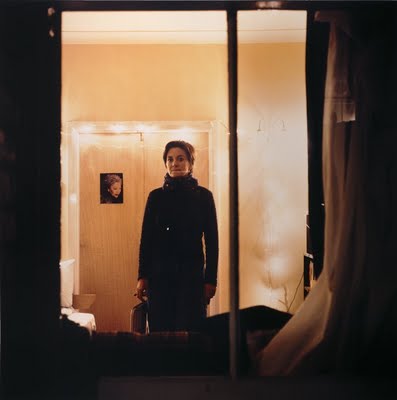
After numerous attempts at photographing unsuspecting people by getting a glimpse of them through their flat windows, Yokomizo became frustrated by the one-sidedness of what she as trying to achieve. She felt it was a vital point that the subject, a stranger, felt the same way about her when she photographed them, therefore wanted them to make eye contact to show awareness of her existence. Thus lead to Yokomizo creating a simple, anonymous letter that contained the possibility of agreement and a time to contemplate taking part with in the project. Her project reveals a shadowy, indistinct boundary between public and private. As this was a planned event, the subject would have chosen their appearance, maybe also the way in which the room they were photographed in looked. Objects that usually seem basic become thorough and intimate. They become more noticeable in a photograph where as on a daily basis maybe unrecognized or noticed. But more importantly, the tension that is created within the series of photographs between the subject and Yokomizo herself creates the feeling of surveillance.

Shizuka Yokomizo
Stranger no. 1 - 1998 - 2000
Shizuka Yokomizo
"Stranger no. 2" - 1998 - 2000

Sophie Calle
“L’Hotel” (1981)

Very similar to a detective or crime photographer, Sophie Calle created “L’Hotel” over a period of three weeks whilst working as a temporary chambermaid in a hotel in Venice. This allowed her to spy on guests and photograph the way in which they left their rooms. A sort of insight into the way other people live.  The role of the objects she photographs is dependent upon the viewer’s perspective, allowing them to create the own story about the unknown person in which the items belong too. 
Sophie Calle
"The Hotel; Room 28" - 1986

Sophie Calle
'The Hotel; Room 46" - 1986


The Body as an Aesthetic Object


When browsing articles via Athens based on ‘The Body as an Aesthetic Object’ I found the most common occurrence was the female body, both nude and clothed, the majority of them containing elements of fashion. Thus supporting the male gaze, as women are being exploited and judged on the way their body looks, expressing a feeling of joy and pleasure.


Nikolai Bakharev.


Bakharev's main concern for this project was people - majority being women - and their intimate, everyday surroundings. Photographing women from the very heart of Russia in their own home; showing them frozen in erotic poses. Offering a strange and aesthetic vision of beauty and freedom, theses series of images are powerful in the sense we are in a way invading the woman’s privacy. There ‘average’ figure add a more casual approach in comparison to the images that appear in the modern media today. Although this is now due to photo manipulation, personally, I think this is the ‘aesthetic body’ in which we compare ourselves too today.

“Photography is for me a need, the need to express and to communicate. As long as the need will exist, I will create.”
                                - Angele Etoundi Essamba.


Whether this is dependent on race or just a common occurrence, I found that from browsing different photographers work, black woman were focused upon more for their beauty and not there body parts. For example this image allows us to look deep into the models eyes, enabling us to discover elements of her personality, showcasing and celebrating her beauty, removing it from its colonial confinement to nakedness and claiming its place in the aesthetic and artistic category of the nude.