Showing posts with label Nikita Gill. Show all posts

Tuesday, 6 March 2012

Composites as a visual aid for social commentary


In May 2010 ITN NEWS posted a video onto their youtube homepage telling the story of a toddler from Sumatra who had been addicted to nicotine since the age of 2. 
  

The video garnered much attention in the media for highlighting the perceived faults of the parent’s who introduced the child to smoking.
Inspired by this video was Belgian photographer Frieke Janssen who went on to create a series of portraits of children composed in different era’s for whom it would not have been averse to smoking


Frieke Janssen - Smoking Kids
 Personal Project 

from a young age. Seemingly taking inspiration from the 19th century daguerreotypes, Jannsens portrait stike an uncomfortable cord for smoking and non-smoking adults alike as the act itself is added to by the fact the children are wearing make-up typical of adults from different societies.
At first gland one might think Frieke Janssen has in fact glamorized the aesthetics of smoking, however the use of  lighting and facial expression suggests the darker side of it.

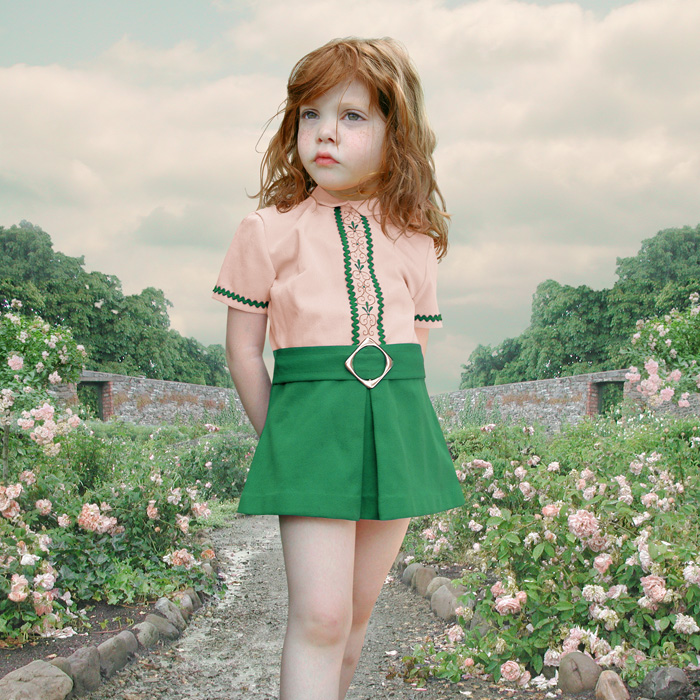
Visually I think another photographer who uses the idea of the social comment of society is Loretta Lux whose composite images portray the seemingly genetically enhanced subject matter in a mythical utopia on first glance. A closer inspection leads the viewer to question the thin line of genetics and the idea of creating a ‘designer’ baby be it for aesthetic or medical purposes. 
Loretta Lux- Rose in the Garden 2001
Loretta Lux - Sasha and Ruby 2005


Smoking Toddler: http://www.youtube.com/user/itnnews/search?query=baby+smoking


Frieke Janssen - http://frieke.com/#!/projects/
Loretta Lux - Works III and Works V http://www.lorettalux.de/


Tuesday, 21 February 2012

Raphael Dallaporta - still life (web)

Landmines look like fruit.

 Blu-3/B aka The Pineapple, USA © Raphael Dallaporta

They also happen to look like perfume bottles, absorbent sponges and cookie jars. A strange analogy maybe, to describe these tools of devastation in such a fashion but this is an observation to which I am not alone; Foam.org described the collection as "pleasantly coloured" and "simply framed" (oct 2011) - thus lulling the viewer into a false sense of security that these still life images do nothing more than act as just that, still life. It is only on closer inspection of the accompanying text that one can grasp the full extent of their purpose.

 B-40, USA/Vietnam © Raphael Dallaporta


GMM1-43, Germany © Raphael Dallaporta


This makes for uncomfortable viewing as you start to have visions of the damage caused by the landmine to the unfortunate people who, like you, were deceived by the pretty wrapper that it was contained in. By entitling the project 'Antipersonnel' the work takes on a different kind of metaphor in to the anti-personNAL nature of the images themselves and possibly alluding to the chilling thought that these objects are still very present, hiding in plain site.

Raphael Dallaporta
Antipersonnel
35 Ilfochrome prints (24x30cm) with captions.
http://www.raphaeldallaporta.com/projects/antipersonnel

Foam Press Release | 6 June 2011
http://www.foam.org/press/2011/raphael-dallaporta

Identity - Journal

Identity can be formed by numerous things such as age, gender, race, nationality, the environment in which are in and the beliefs that we hold etc. We fundamentally categorize ourselves within each of these criteria in order to understand ourselves and our relationship with others with many photographers using different visual tools in order to represent their own ideas of what identity can be.
One such photographer, Martin Usborne, has chosen to do this in the form of portraiture in an unconventional for. Speaking of an experience in his youth when he was left in a car, Usborne said;

"I don't really know when or for how long....the details don't really matter. The point is that I wondered if anyone would come back....It seems trivial now but in a child's mind it is possible to be alone forever" (Martin Usborne, BJP 2010:23)

 Peggy © Martin Usborne 2010

 Pospero © Martin Usborne 2010

This statement is a very poignant reminder of what the photographer feels formed and influenced his works in the project 'Mute' (Sept. 2010) in which he recreated portraits of animals locked in their owners cars, a very common occurrence which is often overlooked by the undiscerning passer by. The resulting work shows a real understanding of the helplessness of the situation and the isolation of the animals themselves. Although the photographer agrees that his plight was a fleeting he also reflects and questions the experience and how similar the feeling can be for many, forming a sort of therapy to this end by recreating these traumatic states and effectively allowing the viewers to themselves question and reflect; as he aptly points out:

After all, we are all animals.

Article: A Dogs Life (page 23
Author: Diane Smyth
Photographer: Martin Usborne
Journal: British Journal of Photography
November 2010

Images:
www.martinusborne.com
Peggy: http://www.martinusborne.com/photos/w8z9mpo1u.jpg
Prospero : http://www.martinusborne.com/photos/iaoo3pu2o.jpg


Tuesday, 7 February 2012

Christian Marclay - book

Footsteps © Christian Marclay 1989 
3,500 single sided 12 inch vinyl records 
Installation, Shedhalle, Zurich


Installation art can be described as a 4 dimensional world where height,width, depth and time become the main components within which the art piece exists. Each viewer experiences the work in different ways and thus come to lots of different ways and creates new pieces of art within the initial work. The idea of moving art away from the gallery walls can be attributed in part the work of pop artists in the 60's who raised the question of art as product and thus paved the way for artists such as christian Marclay who fused the idea of sound and vision to create a new interactive form of art.
one such work is 'footsteps'(1989) in which he recorded the sound of his footsteps and overlayed it with the sound of tap dancing onto vinyl records - 3,500 in total. These vinyls were laid onto the gallery floor and effectively walked on by the visitors, they themselves becoming part of the resulting work in which the now scratched and damaged vinyls were packaged up and sold creating a new sound. The question remains however, had these vinyls remained unsold would the piece have become solely about the 'idea' of sound

Magnetic Recording Tape © Christian Marclay 1991
Installation, DAAD Galerie Berlin

Another piece of work created on a much more subtle scale is the work 'Magnetic recording Tape' (1991) displayed much like a hammock and with a recording of the sound of rain, the construction - carries very little density so the idea of the views presence, their breath, can move through and disrupt the shape of the structure and create a sense of a whisp like subtle after effect of a body being there. Their presence effectively create a DNA which has been transferred onto the delicate tape and further adds to the feeling of participation even in it's more subtle form.

Authors: Jennifer Gonzalez, Kim Gordon, Matthew Higgs
Title: Christian Marclay
Published: Phaidon Press LTD 2005
Publisher: Phaidon Press Inc.
ISBN 0714843741

Tuesday, 24 January 2012

The Abject Body - who has the power in this image?


In 1989 Robert Mapplethorpe’s his solo exhibition tour “The Perfect Moment” which he created in the latter years of his life shocked and angered the art world. The images contained homoerotic and sadomasochistic self portraits of Mapplethorpe that were deemed offensive and resulted in the Corcoran Gallery of Art in Washington pulling out of hosting the exhibition in its galleries. Whilst some art institutions chose to display the collection, the Contemporary Arts Centre were charged with obscenity and although found not guilty, raised the questions about how far an artist can push the boundaries of acceptance from the viewer as seen below (Mapplethorpe died from complications arising from AIDS in 1989.)

Mapplethorpe, Self-Portrait with Bullwhip, 1978.

The pioneer of the psychological idea of Abjection was Julia Kristeva who identified in part that “The abject confronts us, on the one hand, with those fragile states where man strays on the territories of animal. Thus by way of abjection, primitive societies have marked out a precise are of their culture in order to remove it from the threatening world of animals or animalism as representatives of sex and murder”
It is clear, with this idea in mind, how images such as the one above may elicit negative reaction during a time when the American public was struggling to deal with the effects of the AIDS epidemic and the idea of the ‘gay plague’; the work divided opinion between the fearful and the culturally tolerant.
The image itself shows a sense of great composition and contrast between the white sheet covering the chair and the black leather whip, boots and belt. I find even myself thinking “if it were not for the bullwhip...” but would my mind follow the same line of the composition? Also, would the image have the same impact? Whilst looking at the image you are confronted with the idea of servant and master, something Mapplethorpe has portrayed in equal measure.


Joel-Peter Witkin
Ars Moriendi 2007
http://www.edelmangallery.com/witkin54.html

Venus and Cupid with a partridge, Titian c.1500 


http://www.artchive.com/viewer/z.html
This idea can also be seen later much later in the work of Joel-Peter Witkin. The image Ars Moriendi (2007) show a woman reclining nonchalantly on a velvet throw, the image appears to be based on Titian's Venus and cupid with an organist(c.1548-9) with the putrefied head symbolizing cupid. Maybe the photographer is making a statement about the mythological subjects he has appropriated; cupid is dead...desire is dead. He also may be eluding to the prosperity of the independent female figure - notice the mirror and the unsightly heads in the foreground (possibly the heads of adonis who abandoned her)

Diane Arbus and the New
Diane Arbus was a photographer who was known for photographing people on the fringe of society; people who are slightly removed from what could be deemed “acceptable” and makes them so.
Take this image as an example; his hair in curlers, eyebrows plucked, nails done and make-up in process could be just another woman in the act of getting ready for the day if it were not for the overtly masculine nose and jaw line.
It is alledged that somebody spat on this image during its exhibition in 1967 which again shows the almost physical aversion to the ‘other’.

Diane Arbus, A young man in curlers at home on West 20th Street, N.Y.C. 1966

                
Anonymous 60 year old phone sex operator, Phonesex Series, Phillip Toledano. Circa 2008

A much more recent example of this fringe society is this image of an old woman who, although not fully exposed, pushes the boundary of what is considered descent.
What is similar about the idea is that the identity of the 2 sitters is that they both participate in something that we know exists but only as something ‘other’
Both photographers confront us.
 Tattooed man at a carnival, Diane Arbus circa 197

An example by Arbus of a man at a carnival who could have very well been part of a freak show.
Rick Genest and Andre Pijic for Auslander by Marcelo Krisilcic
Rick Genest a man with a full body tattoo of decomposing flesh and exposed brain alongside androgynous model Andre Pijic who frequently models female clothing for major fashion houses.


IANA, Phillip Toledano
       

ALLANAH, Phillip Toledano          

 
Taken from the series “A new kind of beauty” Toledano photographs people who have undergone extreme surgery to become physically what they are psychologically. We recognise the body parts of a woman but some cannot quite acknowledge the idea of the complete feminine and instead choose to define it by ‘gender identity disorder’. However, the images are taken in what appears to be celebration of the ‘other’ highlighting the new kind of beauty in a classical portrait style rather than an anthropological sense, thus highlighting the idea that photographs of the abject body are important in terms of allowing us  to find a way to accept the unknown.