Showing posts with label Claire Pitchford. Show all posts

Monday, 22 April 2013

Understanding Installation Art - Mark Rosenthal


In this exert from his book, Rosenthal goes someway to explaining what constitutes this genre of art and where its' origins began.

As early as the 15th century evidence can be seen in Fra Angelico's paintings in the monk's cells at San Marco of an environment being intrinsic to decisions made when undertaking the paintings. In the Lascaux Caves in France, paintings thought to be more than 17,300 years old, embrace the rhythmic uneven surface of the caves to portray features of animals thought to have lived there.

Fra Angelico, Mocking Of Christ, Convento de San Marco, Florence, Italy (1440 - 1441)

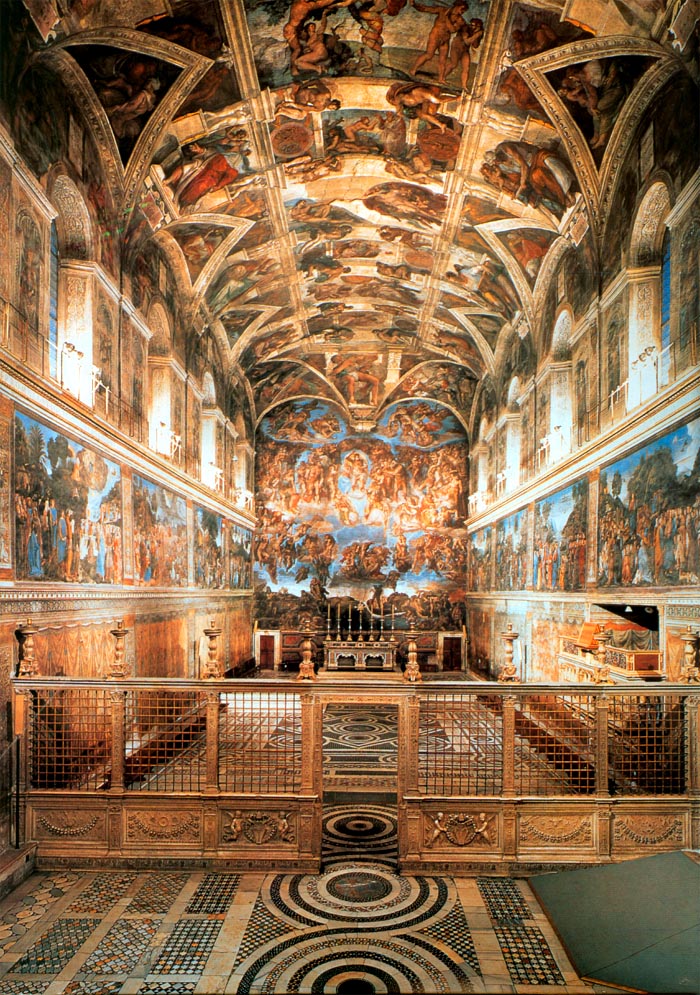
Michelangelo adopted this method of 'site specific' art when painting the Sistine Chapel and Laurentian Library. Rosenthal suggests the connection between early art and its enveloping space has often been ignored. That these examples that have paved the way for modern and contemporary artists who make the surrounding space integral to their art. Thus broadening our horizons as to what constitutes art.

Michelangelo, The Sistine Chapel ceiling, Vatican City, Rome (1508 - 1512)


The many facets of installation art have made it difficult to define and to understand. For this reason it has struggled in gaining recognition. Rosenthal makes the point that its necessary interaction and subsequent intimate relationship with the viewer breaks through traditional (and literal) boundaries that typically separated the two.

 In comparison to art (in the traditional sense) and sculpture, installation does not sit on a throne to be revered by its audience. It does not require merit for its artistic value as an object but instead for its ability to engage the senses in an altogether deeper experience.  Accomplished in a multitude of scenarios, installation art can more easily be defined by a space with usually more than one object, or no objects at all but ultimately where the overall space is central to the art or greater than its components.   
                                                                                                                                              
Many artists have long since positioned themselves on the cusp of art in its historical context. Citing a need for something that incorporates 'the experience of life'. Robert Rauschenburg once said he operated, ''in the gap between art and life''. Installation is suggested therefore as an investigation of life and is such about a temporary time and space. It is the artists intention that installation and viewer both in their state of transience, come together in the present moment and experience an intertwining.

While Installation art is diverse Rosenthal proposes a grouping can be made under two headings - ''filled-space installation'' and ''site-specific installation''. The first is defined by the possibility of recreating it with ease at another site due to the fundamental relationship being with its other parts rather than the space it inhabits. The latter bears a correlation both to its parts and to its location. Moving it would disrupt its whole meaning.

Monday, 11 March 2013

Photography as Family Therapy - Books

In revisiting the family home he grew up in, Duane Michals (aged seventy at the time of this work) reflects on vivid memories stirred up by the bones of his old house. To him, 'This abandoned wooden box is, the cabinet where my family's curiosities are stored.' Duane Michals, The House I Once Called Home, 2003. Looking out at the scene beyond what was once his bedroom window, he recalls through a child's eyes, how he had perceived the world and what lay ahead. What had been his window to the rest of the world he now recognises as the 'soiled city' before him.

Duane Michals, The House I once Called Home, USA, 2003

Equally he tries to reconcile his memories of his immediate family with Sonny, 'When I was a boy, everyone called me Sonny', and the man that now stands in the same place and purveys those same memories with all his wisdom and clarity.  To give in to nostalgia protects Sonny. Without him, he too is dead. 

The sentiments he brought to this place - the longing to revisit his past and all its stories are now tinged by the actuality he has unlocked within these walls.His alcoholic father, his mother locked in a loveless marriage, the suggestion of his brothers suicide and his grandfather's King 'Lear' like presiding over his family. All this interspersed with recollections of Billy 'a tom too nosey' and the succession of his Grandmother's cats all named, '...Petunia, after her favourite posey', serve to sweeten the harshness of what was.

Duane Michals, The House I Once Called Home, USA, 2003


We have a tendency to idealise our childhood but in looking back Michals is faced with the reality of his dysfunctional family.Does he reject this notion or accept the reality which will ultimately re-write his childhood memories?

Duane Michals, The House I once Called Home, USA, 2003


Monday, 25 February 2013

Documentary And Story Telling


The tradition of story-telling was brought into the 20th Century when documentary photography established its beginnings shortly after WW1. It brought real life stories about the masses to the masses. As media titles popped up across the globe, demand grew for the role of photographers to provide stories.

Life magazine, Garment Workers at Play (1938)
Editorial control meant the order of events were often disrupted to produce commercially viable stories. This ‘conflict of interest’ between photographers and the magazine’s creative angle led to photographers publishing their own books to retain editorial control.

Documentary was about representing the people, influenced by Factography and Constructivism from the Soviet Union. The idea that knowledge about the world around would lead to people being better educated, documentary photography was thought to be for the greater good of society.

Emphasis on social documentary can be seen as far back as the 19th century in works by Lewis Hine and Matthew Brady. Accompanied by descriptive writings, they addressed the plight of child labor, immigrants, war and the poor. Hine and Brady recognised the only way for reform was to educate and inform the public.


Lewis Hine, Child Laborer (1908), USA
Two types of social documentary photography emerged at this time. That of ‘objective’, instigated by August Sander. His homogenous subjects – expressionless, with emotion only conveyed from the context of the setting.  The second described as ‘subjective’ - someone captured in the moment with their expression suggesting the context. Each was thought to favour different techniques such as depth of field and shutter speed.

Peter Wollen highlights how documentary, news and art photographs each reflect  - process, event and state and how this is seen collectively in the narrative of early cinema. He suggests social documentary encompasses all three. Walker Evan’s work with the Farm Security Administration is cited as a prime example, eliciting the ‘snap shot’ style photography and cropping of Reportage.

Walker Evans, Alabama Tenant Farmer (1936), USA
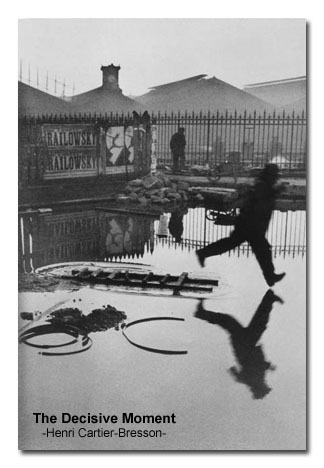
Often seen in news stories, the art of presenting past, present and future, fused together in one single moment ‘the peripateia’ is best seen in the work of Henri-Cartier Bresson. A story told in one single moment. However the chosen composition to do this raises criticism as to the reality and interpretation of events.

Often categorised by its monochromatic qualities until the 1980’s, the truth was associated with black and white. As a shift towards colour grew so did the return to older snapshot styles in a bid to authenticate the colour image as documentary and as a growing art form.

Monday, 28 January 2013

The Abject Body

From its earliest beginnings photography has presented images of the body in a less than beautiful guise. With the Victorians infatuation for photographing the dead and experiments around the theory of Phrenology, to photojournalism portraying images of war and suffering.

The likes of Diane Arbus and Cindy Sherman are artists synonymous with photographing subjects at opposite ends of the spectrum to that which might be deemed eye pleasing. In Cindy Sherman’s series Fashion, 1983, the artist offers herself up as numerous high fashion models that do not typify beauty, conventional or otherwise. I would go as far as to say some are intended to repulse. 
Cindy Sherman, Fashion (1983)
Similarly for his depiction of the lesser known rural provinces of South Africa, Roger Ballen sought out those living on the fringes of society. Only those that made uncomfortable viewing, the grotesque and the disturbing, made it into his images. 
Roger Ballen, Dresie and Casie, Twins, Western Transvaal(1993)


Roger Ballen, Puppy Between Feet, Outland (1999)


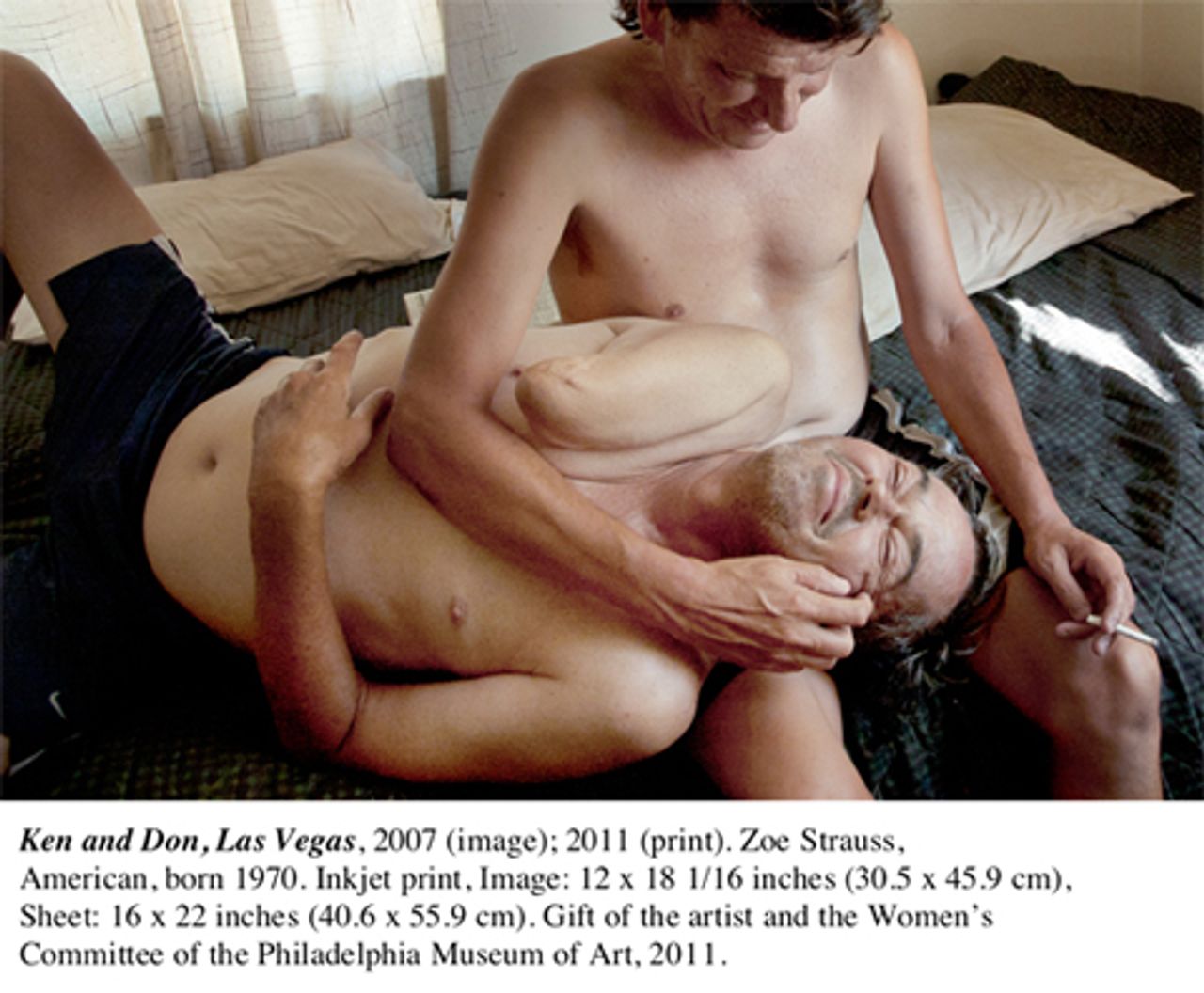
Subjects of this nature appear to be pursued for their artistic value. But there are questions surrounding them - questions of morality and motive. Professor of English and American studies, Miles Orvell addresses the delicate nature of ‘bringing ‘’art’’ to the people’ through street photography, in an accurate and fair representation of the subject without the art being at the expense of the people. In some instances, he suggests the photographer is driven by an assertion of power over the subject.  He feels such images can elicit a sense of ‘them and ‘us’ and are an act of voyeurism. In Orvell’s article, THE ABSOLUTE POWER OF THE LENS: ZOE STRAUSS AND THE PROBLEM OF THE STREET PORTRAIT (Afterimage; Sep/Oct2012, Vol. 40 Issue 2, p10-13, 4), he considers the work of Strauss and artists she has been likened to. The bizarre, the stereotyped, the outcasts and those who deviate from what society deems as the norm, have all been their subjects. Orvell compares the ethos of these artists and subsequently the moral perspective from which they stand and shoot. 


In the case of Zoe Strauss: 10 years, on the face of it, a relationship based on trust has been achieved between photographer and the sitter. However, based on the lack of knowledge the sitter has on the portrayal and future use of this very personal image, Orvel suggests (despite numerous critics reviews to the contrary) that is may be naivety on the part of the sitter and exploitation on the part of the photographer. In singling out and drawing attention to the subject’s anomalies across giant billboard posters– scars, 
missing fingers, a bruised face… is Strauss’s cause(intentionally or not) only heightening them as anomalies within society and making them a talking point for our viewing pleasure? 


daddy tattoo womanemail copy
Zoe Strauss, Daddy Tattoo, Philadelphia (2004)

monique showing black eye web
Zoe Strauss, If you Break the Skin...( 2007)


To further emphasise his point Orvell compares the work of Diane Arbus to Strauss. Norman Mailer, a writer and journalist is quoted as saying of Arbus, ‘Giving a camera to Diane Arbus is like putting a live grenade in the hands of a child. Troubling but always fascinating.’ (Newsweek;10/22/84, Vol. 104 Issue 16, p88). 

But Strauss was it seemed, engaged and interested in her subjects beyond the decisive shot of that particular day. They were more than merely to 'facinate'. The two images above are of the same girl taken two years apart. The first, 'Daddy Tattoo' featured in Elle magazine. The girl's mother wrote to Strauss telling her of her daughters death in 2006, to thank her for taking the photograph and to tell her of her daughter's joy at being in the magazine. There is apparent exploitation but it does not appear to be on the shoulders of the photographer in this case. It is possible that in some cases, exposure and suffering is necessary or the point is lost.

In establishing his position, Orvell described Richard Avedon's In the American West (1985)to have been taken from a position of power. Avedon was 'the man with the camera', 'the master', 'the outsider'. He photographed only his subjects torso leaving the eye drawn to what he wanted the viewer to see. A detachment was made that made the photographer the voyeur.

His opinion differs on the work of Mark Morrisroe who recorded the world of Aids sufferers and prostitutes with himself as the main subject and at his most vulnerable.

Mark Morrisoe, Self Portrait (to Brent) 1982
Mark Morrisoe, Untitled (Self Portrait) c. 1989


Nan Goldin, Nan One Month after being battered (1984)


© Nan Goldin, courtesy Matthew Marks Gallery, New York
Nan Goldin, Greer and Robert on the bed, NYC (1982)


Similarly with Nan Goldin who was very close to her subject matter, depicting the world of gays and transexuals. The Ballad of Sexual Dependency (1981), included photographs of close friends dying of AIDS.


In both examples of Morrisoe and Goldin, Orvell highlights the difference - that as 'insiders'they have the privileged position of seeing the world from the subject's perspective but most significantly that from this side of the fence, the photographer is not the voyeur, we are. 


Monday, 3 December 2012


Seminar 6: Photography Goes Social - Post War Years


The Great Depression sparked Joseph Rosenthal (1911 – 2006) interest in Photography. After first being turned down to work for the US Army as a photographer due to inadequate eyesight, he later joined a US news agency co-operative, the Associated Press and went on to win the Pulitzer Prize for his image of the Americans raising the flag, following capture of the island of Iwo Jima from the Japanese Empire. 

Joseph Rosenthal, Raising the Flag on Iwo Jima, 1945.
Documentary photography was firmly established and seen as a means to record both the unfamiliar and events in history. George Roger, a founding member of Magnum photographic agency, along with Henri Cartier-Bresson, Robert Capa and David 'Chim' Seymour was most noted for his photographs of the aftermath at the Nazi concentration camp, Bergen-Belsen and for his works in Africa. 

George Roger, Bergen-Belsen, 1945.
The Americans, by Robert Frank (highlighting the cultural dynamics in the USA, was published (first in France in 1959, then the USA) in 1959. Documenting the diversity of America over two years and in 28,000 images, out of which, 83 were selected for the book. Walker Evans’s work had been hugely influential on Frank and it is thought he helped him gain the funding required for him and his family to spend the two years travelling across the States. The book was said to have emulated Walker Evans' own book, American Photographs. Robert Frank, himself an immigrant from Switzerland highlighted the isolation of some cultures and those living on the fringes of society.

Robert Frank, The Americans, 1959
Diane Arbus (1923 - 1971) also documented those who were considered to deviate outside the norms of society. Her images were hard hitting and controversial.Some felt she was exploiting her subjects for financial gain. Arbus commited suicide in 1971 at the age of 48. It was only after her death that her work achieved real acclaim. Susan Sontag (1933 - 2004) suggested she was highlighting these individuals as outcasts of society from her own elevated position within it.


Taking his influences from Walker Evans, Robert Frank and Henri Cartier-Bresson, Gary Winogrand portrayed documentary photography in America in the 1960's. Through the lens of a 35 mm camera he highlighted the social impact of the media on society, the candid imagery of women on the streets he deemed beautiful (or thought if not within the realms of accepted beauty, that he could portray as beautiful) and the animals of a New York zoo.

Gary Winogrand, The Animals, Bronx Zoo, 1969.

In the 1960's the liberation and independence of women, brought about by contraception  altered  the approach to fashion photography, not least of all influenced by David Bailey's alternative approach, which was at first rejected by Vogue for its unconventional depictions of models. Inspired by Terrence Donovan's (1936 - 1996) often gritty, industrial backdrops in sharp contrast to the beauty of  his models, Bailey developed his own style and added further sexual tension to his images of Jean Shrimpton.


David Bailey, Jean Shrimpton, New York, 1962.

Political liberation, a move to left wing policies and The Civil Rights Movement all accounted for huge changes in the 'Swinging Sixties'. The high cost of colour televisions (although available in the USA in the early 1950's ) restricted purchases until more affordable in the 1960's and was not available in the UK until the late 1960's when the world could be finally be be viewed in colour. An instant color film was introduced by Polaroid in 1963.

In 1972 more than 70 photojournalists including John Neubauer, Bill Strode and Dick Swanson were commissioned by the Environmental Protection Agency in project 'Documerica' to document areas that were were being threatened by environmental factors across the USA. There were similar bias and conflicting interests felt to that of the Farm Security Administration during the documenting of 'Dustbowl' of the Great Depression. More than 15,000 images were taken for the project over 5 years.


Dick Swanson, Bicyclist Holds Ears As Jet Aircraft Roars Off From National Airport. Nearby Are A Marina And A Waterfowl Sanctuary, May 1973


Sunday, 2 December 2012

Seminar 5: Modernism Finds a Voice (high modernism)

The Russian Revolution in 1917 paved the way for propaganda (and Constructivism), seen as a tool to brainwash the masses with political messages. In the absence of any broadcasting means to communicate (radio existed but it was not commonplace), propaganda through print, became a prolific vehicle for spreading the (one sided) word as a means of influencing its audience.

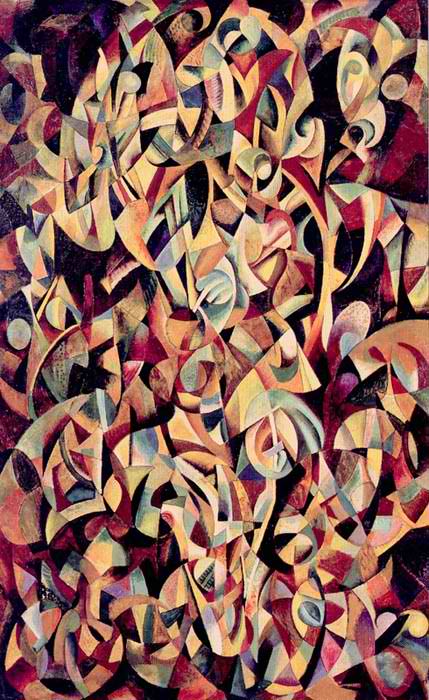
Constructivism was thought to have evolved out of Futurism with strong influences in Cubism. Alexander Rodchenko was one of the founders of the movement. A painter and graphic designer, he later moved into photomontage,a technique first developed by the Constructivists . He used a Leica camera to record everyday life in Russia and was renowned for his unusual, exaggerated perspectives. His photomontage of Lilya Brik promoted the availability of (soviet approved) ''books'' at the library.

Alexander Rodchenko, photomontage. 1924. ( Lilya Brik, the muse of the poet Vladimir Mayakovsky, cries out “books”, 

Alexander Rodchenko, Dance. 1915.
Kasimir Malevich (1879 - 1935) and El Lissitzky  (1890-1941) were well known for their contribution to Russsian propaganda. They were responsible for the Suprematism movement and though opposed to Constructivist principles, it was a major contributor. El Lissitzky's poster for the Russian Exhibition in Zurich, 1929 was aimed at the younger generation, promoting a future in, a utopia that could be achieved under the Red Army.

Gustav Klutsis (1895 - 1938) was a photographer known for his photomontage. He also served in the Russian Army under Stalin. Best known for his propaganda collage of Stalin with its suggestion of the leader bringing electricity to Russia and leading the way across the world as a revolutionary and innovator. 

Gustav Klutsis, Electrification of the Whole Country, 1920.


Contrary to a utopia, made possible by a technical world with less manual labour, Fritz Lang (1890 - 1976) countered this thought with the idea of a distopia where in a world dominated by machines, man might lose control. The city depicted in Lang's film, Metropolis, was said to be based upon his first recollections of New York. The Art Deco features of the buildings portrayed in the film are said to have had been largely influential on the period of Art Deco that followed in Europe.

In spite of his apparent support of technological advancements and championing of its impact on society, Charlie Chaplin saw this an opportunity for one of his films in which Fritz Lang's fears of domination and loss of control of machines is brought to comedic life in 'Modern Times', 1936.


The mechanical age and mass production saw the rise of the consumer society and the Bauhaus (1919 - 1933) in Germany, where it was seen possible to combine both form and function. Everyday objects were revered for their aesthetics and elevated to a status worthy of photographing for their qualities of light, shadow and abstraction.


Paul Strand, Chair Abstract, Twin Lakes, Connecticut, 1916.
With the development of the Leica camera in 1924 and subsequent revisions in 1930 and 1932, came endless possibilities for photography. After seeing Martin Munkacsi's, Three Boys at Lake Tanganyika (c.1931), taken with the 35 mm camera, Henri Cartier-Bresson was inspired by the potential to capture a moment in time for all eternity and began photographing life on the streets. Coining the phase 'The Decisive Moment' it was used many years later as the title for his first published book, in 1952.


While still viewed as a purveyor of truth, in the USA,  in 1935, the USA Farm Administration commissioned a group of photographers including Dorothea Lange and Walker Evans, to record the government efforts with the drought in the south during the Depression. The once independent farmers were sent to work as a collective on large government owned farms. The photographs were intended to portray the government in a positive light in showing their helping hand with the plight of these poor farmers and as a tool to help reform society. 


Dorothea Lange, Migrant Mother, 1936.


Seminar 4: Modern Times – The 20th Century and Early Modernism (1900 – 1920’s)

The co-dependent relationship between man and machine was growing ever wider. A need for human intervention in the mechanical age was on the decline with advancements in technologies.Modernism brought about a general rebellion of historicism. Instrumental to its school of thought was Albert Einstein’s Special Theory of Relativity (1905), addressing physics in terms of space, time (dilation – ‘the elapsed time between two events’) and light. It questioned science as we had known it.

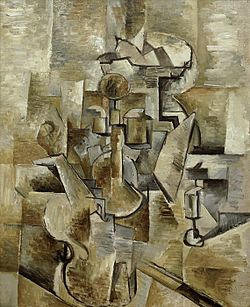
Similarly Cubism (Analytical 1907 – 1912 and Synthentic  Cubism 1912 - 1919) questioned perspective as we had known it, showing it was not definitive but variable dependent upon the angle of the observer which lead to its three dimensional characteristics. Most closely associated with the works of Pablo Picasso (1881 - 1973), Henri Matisse (1869 – 1954), Marcel Duchamp (1887 – 1968), Paul Cezanne (1839 – 1906) and Georges Braque (1882 – 1963), it also expressed movement and considered mass, time and space. Images were expressed as if a life drawing or painting were overlaid with a further image from a different angle as you moved around the subject.

  Georges Braque, Violin and Candlestick, Paris, 1910
Pablo Picasso, Les Demoiselles d'Avignon, 1907


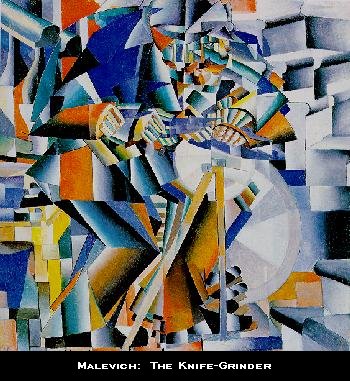
Futurism (1909 – 1916), born out of Italy and influenced by Cubism, was an expression and an embracing of all things new. Abstract in its interpretation, it sought to celebrate speed, the technological age, violence and all things industrial. They wanted no part in nature. Nature was weak, while man was all powerful.

Kazimir Malevich, The Knife Grinder, 1912


Voticism was a British modernist movement, circa 1913 that took its lead from Cubism, favouring geometric shapes and abstract works. World War 1 is thought to have seen the movement run out of vigour.

Photography had begun to gain some artistic recognition for its purpose other than just a means to record but practitioners continued to feel the frustrations of a medium lacking credibility as an art form.

The painterly qualities of Pictorial Photography, championed by the Photo-Secessionists from 1902, had somewhat successfully elevated photography’s status but it still had a long way to go to be seen equal to art. In 1905 in New York, the Little Galleries of the Photo Secession opened its doors to the public. The tiny gallery on 291, 5th Avenue, the brainchild of Alfred Stieglitz (1864 – 1946) and Edward Steichen (a former painter), saw hundreds pass through its doors in its first weeks. This gave the Photo-Secessionists a platform to enter the media and soon their works became a talking point and the topic for debate and discussion. Stieglitz went on to use this notoriety to invite all manner of artists to exhibit at what later became known simply as ‘291’. It was a collective of creative minds – not only photographers and painters but also musicians, critics and poets who would meet and exchange ideas. Most importantly to Stieglitz he saw this affiliation as a way to raise the profile and status of photography.

Picasso and Braque exhibition at 291 (Little Galleries of the Photo-Secession)

In doing so he is thought to have been instrumental in the introduction of Modern Art in the USA.
Providing a gateway into the art world of America, artists such as Cezanne, Matisse, Picasso, Paul and Duchamp held their first exhibitions at 291. Having first exhibited in Paris in 1901, Picasso didn’t think America would be accepting of his cubist works and confirming his thoughts, The Metropolitan Museum are said to have initially rejected Picasso’s pictures. Following an exhibition at 291 in 1911, only two pieces were thought to have sold - Stieglitz being one of the buyers, picking up the piece for between $20 - $40 dollars.

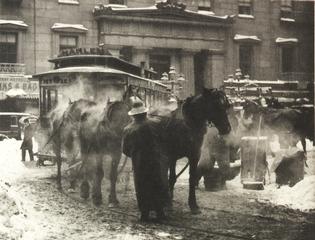
Stieglitz eventually negotiated with the All Bright museum and secured the inclusion of photography in to their gallery on the condition it was hung at regular intervals to other pieces of artwork. While Pictorial photography had opened doors, by this point Stieglitz and many others, influenced by the likes of Picasso, Cezanne and the realist philosophies of Modernism had begun to move away from the soft lines of pictorial imagery, in favor of much sharper images portraying life of the time.

Alfred Sieglitz, The Terminal, 1892


Dada (1915 – 1922), were an anti establishment group who rejected all rational thought and ideas, thinking it was this logic that had led to WW1. Its beginnings were in Switzerland then moving on to Berlin, Cologne, Paris and New York. Dadaism encapsulated many forms of art including literature, photography, film, sculpture and assemblage. In 1916, Dada established regular meetings at an underground club in Paris’s red light district. They eventually came to an end later the same year due to their reported excesses and wild behavior and to set up at a similar venue - Galerie Dada. 

Marcel Duchamp's, Fountain, 1917, replica 1964


Positioning itself as almost anti art, it claimed to be against art in the traditional sense and that which could be found in galleries, instead favoring the kind of art they expressed at The Cabaret Voltaire and examples such as Fountain, Marcel Duchamp, 1917 (photographed by Alfred Stieglitz). Dada works were described as being based on chance and random events and sometimes just to mock. It was highly influential on the Surrealist movement that followed. 

Thursday, 8 November 2012

The Photo-Secession and Pictorialists


Seminar 3: An overview...

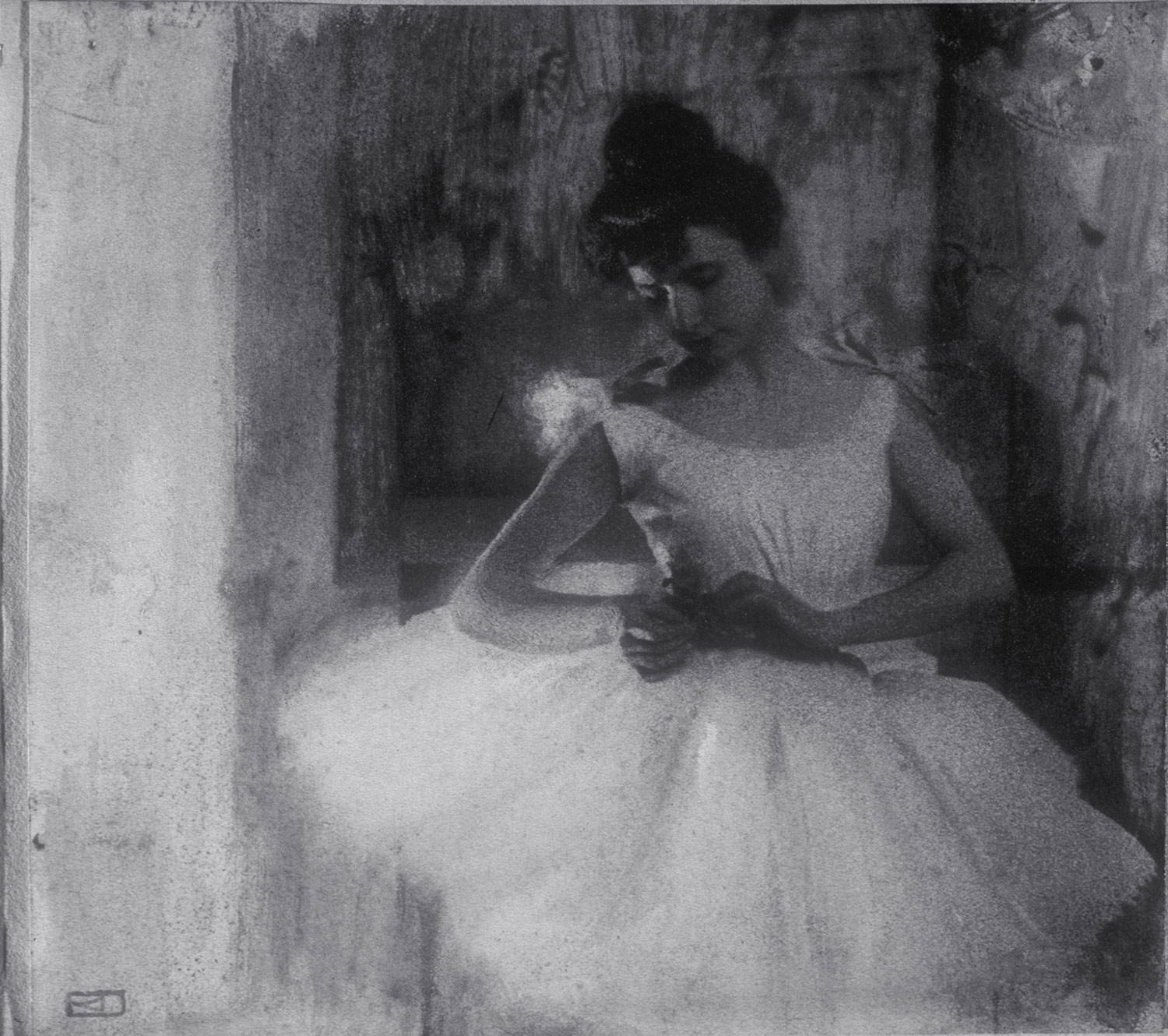
The Pictorial movement (1885 – 1915) was a particular style of photography thought to have been influenced by Impressionism and artists prevalent at the time, namely the Pre-Raphaelites. It was established in response to some debate surrounding photography being seen as a means of documenting and recording and as more akin to chemistry than art. In an attempt to elevate it to an art form photographers began to draw upon painters for inspiration. They began to consider how photographs could evoke the same emotion on a viewer as paintings. Below is an example of a gum bichromate print by French pictorialist Robert Demachy (1859 - 1936). 

Robert Demachy. Une Balleteuse, 1900
Just as artists could manipulate their paintings, photographers could also manipulate their art form by controlling the effects of the final outcome with such things as soft focus lenses, by diffusing an image and using a variety of processes including platinum prints which had a very rich tonal quality, photogravure and gum bichromate.  An Arabic gum solution and bichromate (also known as dichromates) were used to produce gum prints. The light sensitive qualities of dichromates were said to have been discovered in 1839 by Mungo Ponton, a Scottsman from Edinburgh who unlike Fox Talbot didn’t patent his invention. A negative was placed between glass with the sensitised paper (paper washed with Arabic gum, watercolour pigment and a dichromate) and exposed to light. The gum hardened over the areas exposed to the most light and the presence of the pigment created shadows. 

Water was used to wash away the remaining pigment and dichromate leaving an image that was more even in tone with less contrast. While still wet, shadow areas could be manipulated with a soft watercolour paint brush or water spray for different painterly effects. The results varied and similar to that of a painting, no two images would be the same. This method focused on the process rather than the image capture much in the same way as the labour intensity of a painting. The process could also be repeated or layered to alter the results. The image below of The Flatiron, 1904, by Edward Steichen (1879 - 1973) is an example of a layered print - gum bichromate over a platinum print. 

Julia Margaret Cameron. The Nymph Sweet Liberty 1866
While on the brink of a new era, a new century and looking toward the future with all its technical advancements there was also a sense of looking back, of trepidation and a yearning to return to nature and all things organic. As industrialisation took hold, people wanted to cling on to something familiar. The Pre-Raphaelites had strong religious and Shakespearean connotations in their works. Shakespeare drew on Greek myths and morality, both of which contributed to the basis of Victorian beliefs. The Victorians began to set up theatre in their own homes and acting out Shakespearean plays became a regular pastime. Medieval times and romance were also part of revisiting these eras and themes contained within Pre-Raphaelite works. The portrayal of innocence, nature and mythology is thought to have been reflected in Julia Margaret Cameron’s image (and in it's title), The Nymph Sweet Liberty, 1866 in which she used a worker at her residence in the Isle of Wight as her sitter.

Many of the Pre-Raphaelite Brotherhood had close links with the Arts and Crafts Movement (c. 1860 - 1910) - a further rejection of industrialisation, machines and mass production, in favour of skilled craftsmanship and raw materials, echoing gothic and romantic design.

In 1869, Henry Peach Robinson, (referenced in the last seminar notes for his photograph Fading Away, 1858), wrote a book on the relationship between photography and art. He suggested that by the act of producing images made up of different negatives (said to be 5 separate negatives in the case of Fading Away), he had affected art in the form of photography. He championed photography as an art form and suggested that photographers were governed by the same laws as painters thus equal status should be given. 

Peter Henry Emerson. Gathering Water-lilies, 1886
Peter Henry Emerson was interested in the different qualities of light. As with Impressionist painters who also paid particular attention to light. In his most famous piece, Gathering Water-Lilies, 1886 depicting a romantic notion of life on the Norfolk Broads, (thought to be controversial due to the inaccurate portrayal of life there at the time), he shot at different times of the day to capture both the early morning and dusk light. He didn’t intend for the images to be too sharp or too soft, but just as the eye would see them, in his words, ‘naturalistic’. 

French artists Claude Monet (1840 - 1926), works are thought to have been influenced by photography. As well as the impact of light in a composition, Impressionists were concerned with capturing a moment in time. The quick brush strokes, layering, lack of hard lines all gave an 'impression' of a fleeting moment, of movement. Just as a camera would freeze frame a moment in time. Many of Monet's compositions suggest movement - lilies floating on water (many include water), a hill to ascend or descend, a person in motion, a skirt, a blade of grass, a parasol moved by the wind.

Renoir. Luncheon of the Boating Party, 1880 - 81
Renoir, said to be a close friend of Monet's, in his painting Luncheon of the Boating Party, (1880 - 81) captures a new concept of middle classes - the work/pleasure balance depicting movement by showing subjects only partially in frame. This deliberate  cut off point gives the impression of a photograph. Attention is not drawn to the centre of the composition but on what is happening all around, particularly where someone is partially out of the scene.

Returning to nature and medieval times was expressed not only through photography, and the arts but also in architecture. There was a gothic revival both in the UK and Europe. In the early 20th century, Gaudi’s creations began to take shape across Spain, mostly in Barcelona. Gaudi himself had a love of nature and the natural elements of the world around him and was devoted to the Catholic religion. His architectural practice echoed his spiritual beliefs and followed more of a natural process too. It is said he rarely drew plans in the initial stages for any of his buildings, preferring instead to make models and let the building evolve once construction began. Believed in part to have contributed to the complications with Sagrada Familia, still now in construction, 129 years on and 86 years since Gaudi’s death in 1926.

Frederick Evans. Wells Cathedral: Stairs to the Chapter House, 1903
Frederick Evans was a major contributor to pictorial photography on the subject of architecture. He looked at the way natural light fell on the natural elements of the building. He used mostly platinum prints.

Developments at the end of the 19th century in the USA were coming on in leaps and bounds. Having first patented a machine that could mass produce dry gelatin plates George Eastman set out "to make the camera as convenient as the pencil". In 1888 the first Kodak camera was made available on the market for amateur photography. For the first time everyday people could document and record their own lives. By this time photography was a widely accepted practice worldwide. In 1900 the Box Brownie was introduced. 

In 1897 a group called the Secessionists was founded in Vienna by a number of artists,  and presided over by one of its founding members, Gustav Klimt. 'Secession' is a latin word meaning to disassociate from an organisation or a 'political divorce'. The Secessionists principles were just that, they wanted to deviate from what was considered within the normal confines of art and open the definition up to art and crafts and new forms of art. This could be seen as fighting old regimes and establishments in Western Europe but pivotal to their vision for this Art Nouveau that began to break through in the form of young new artists coming to the fore, was nature and the organic.

The Photo-Secession evolved in the early 20th century (c. 1902) out pictorial photographers aspirations to firmly establish photographers as serious art contenders. It was also as the name would suggest, influenced by the (Munich) Secessionists. A members only society for like minded photographers was headed up by Alfred Stieglitz, born in Austria but having lived in the USA from an early age. Stieglitz initially formed the group to give credibility to an exhibition of contemporary American photographers, he had been asked to organise.

Following the invention of Edison's light bulb in 1880, electricity followed shortly after, illuminating cities at night enabling night time photography. Other technological steps forward facilitated photographic opportunities, including the invention of the motor car in the 1890's and flight by the Wright brothers in 1903. 

Edward Steichen. The Flatiron, 1904